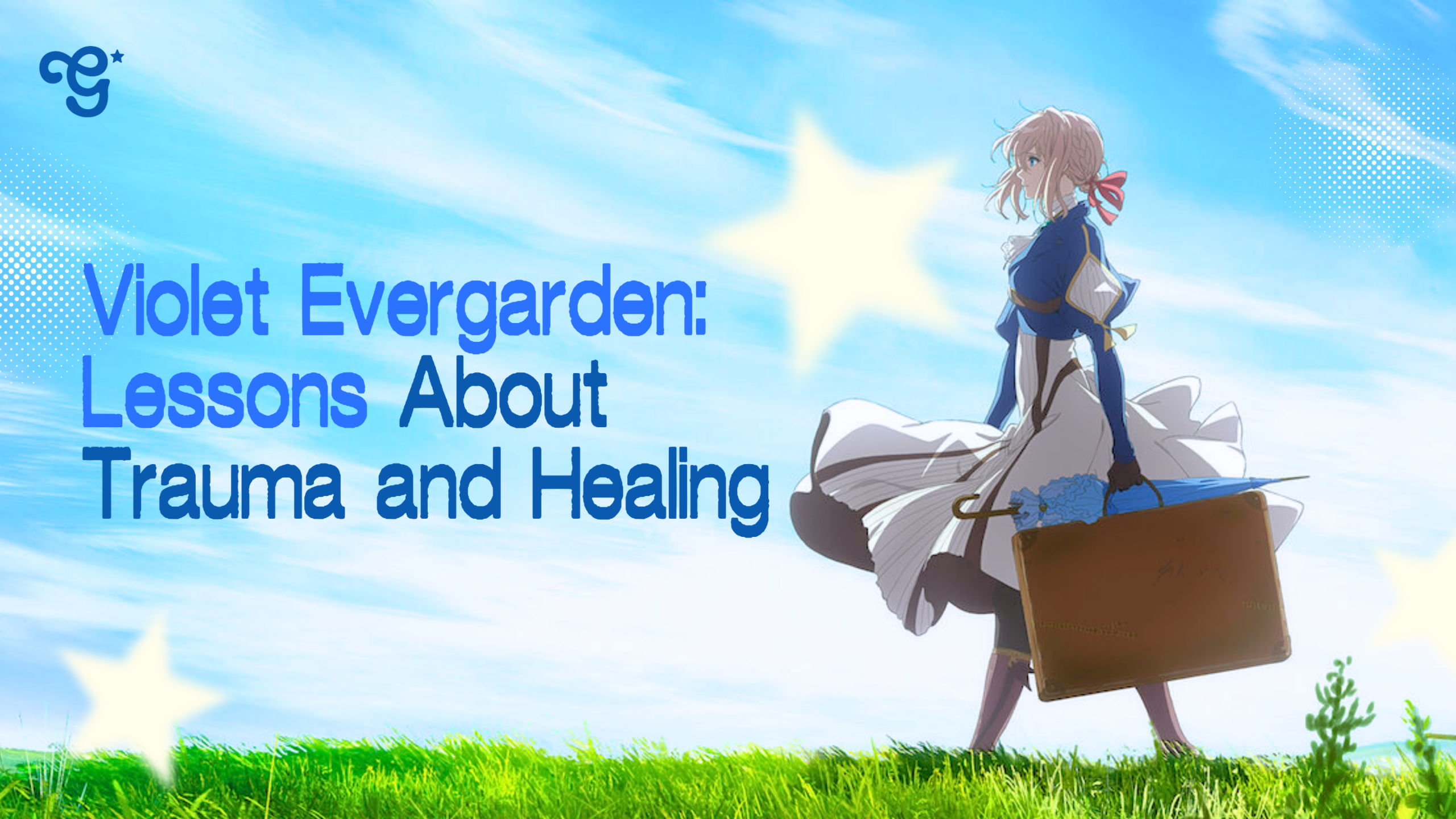
Violet Evergarden takes place at the end of a war and follows Violet, a former child soldier who lives under the care of a retired military officer named Claudia Hodgins. In the first episode, she wakes up in bed, fitted with metal prosthetic arms after losing her own in the war’s final battle.
Spoilers for Violet Evergarden Season 1 | TW: War, violence, PTSD, substance use, death
While in the military, Violet served as a subordinate to Gilbert Bougainvillea (aka the Major). The Major put a young Violet on the warfront, but also raised and protected her. Before being engulfed by rubble, the Major (presumed dead) tells Violet he loves her, and begs her to live on freely. Violet, who has never even heard the word “love,” declares when she wakes up: “I want to know what ‘I love you’ means.”
She sets off on her path to understanding “love” by joining CH (Claudia Hodgins) Postal Company. She works as an Auto Memoir Doll alongside fellow Dolls Cattleya Baudelaire, Iris Cannary, and Erica Brown. As a Doll, Violet writes letters on behalf of clients trying to express their deepest feelings about trauma, love, and loss. As the anime follows Violet’s journey, it explores different aspects and nuances of post-traumatic stress disorder (PTSD) in depth.
The depiction of dissociation and depersonalization

Violet was trained to inhabit a state of depersonalization and dissociation as a trafficked child soldier. The subsequent trauma she endures in battles compounds the initial trauma, leaving Violet guarded, numb, and mentally unresponsive.
Ample research has found it’s common for people with PTSD to experience depersonalization and dissociation to some varying degree. According to the organization PTSD UK, “A person who is dissociating could appear emotionally numb or divorced from all sensory experience. They express this as a dreamlike state, where the world is ‘foggy’ or blank.’ … People with dissociative conditions sometimes feel like a robot or zombie.”
Simply put, dissociation protects your nervous system from experiencing intense stress, grief, and pain. When Violet’s fellow Auto Memoir Dolls and clients first meet her, they describe her as a “mechanical doll,” not because of her prosthetic arms and hands. Emotions are so foreign to Violet that when she is asked to convey joy, she physically pulls her cheeks back with her fingers into an uncanny smile.
This intense detachment from the self and others after trauma is not uncommon, but Violet Evergarden demonstrates connection as the antidote. In one encounter, Violet travels back to a war zone to pen two letters on behalf of Aiden, a dying soldier wounded in another country’s civil war. As she pens letters to his parents and the love of his life, the veil of trauma-related dissociation lifts. Tears roll down her face as she holds Aiden’s hands when he passes.
Combat Exposure Trauma

Before PTSD was actually referred to as PTSD, psychiatrists used the term “shell shock.” The “shell-shock” diagnosis was given to soldiers returning to the United States during World War II whose mental health deteriorated. Fortunately, the definition and recognition of PTSD have expanded immensely. Allowing survivors of abuse, natural disasters, loss, and other traumatic events to access treatment with less stigma.
That said, combat exposure-related PTSD is heavily depicted in Violet Evergarden. She was dubbed the Major’s “human weapon” by military commanders. As such, she took the lives of many people during the war. She witnessed brutal killings of her comrades and war crimes before she even turned 14 years old. Notably, much of her trauma is centered on losing the Major, who is presumed dead.
In one of the first episodes of the series, Hodgins tells Violet, “You don’t realize yet, but your body is on fire and burning up because of the things you did…Someday you’ll understand what I said, and then you’ll realize for the first time that you have many burns.”
She takes his words literally, as she physically examines her body for visible burn marks. However, when Violet begins to mentally unravel the harm she caused others as a soldier, her PTSD symptoms appear. She has persistent intrusive memories, flashbacks, and nightmares, particularly of the last battle she fought. Lingering feelings of survivor’s guilt and grief cause her insomnia. Leaving Violet to process the horrific reality of war without the protective layer of dissociation.
As she transforms from a “human weapon” into a person, she understands Hodgins words: “Everything I’ve done so far has sparked a flame that is now burning me up,” she cries.
The anime reflects on the different ways that PTSD can manifest

Though there are shared experiences between people with PTSD, it can also be a uniquely isolating experience. While the anime centers on Violet as the protagonist, it also explores how PTSD manifests in the supporting characters.
For instance, fellow Auto Memoir Doll Luculia has a brother who struggles with alcoholism as a response to the death of their parents and becoming injured during the war. One of Violet’s first house call clients, Oscar Gilbert, also struggles with alcoholism following the deaths of both his wife and terminally ill daughter, Olivia. These losses leave Oscar angry, unable and uninspired to finish a play based on Olivia. Only amidst his interactions with Violet does he begin to open himself back up to the world. And Violet begins to do the same. This is yet another reminder that PTSD cannot be addressed in a vacuum.
PTSD and the Power of Writing
“A word after a word after a word is power,” Margaret Atwood, the famous author of The Handmaid’s Tale, once stated. This quote captures the central role letter-writing plays in Violet Evergarden. Writing can be an outlet for endless things. From unspoken conversations and stories to the exploration of self, trauma, and grief.
At the start of her career as an Auto Memoir Doll, Violet dryly pens letters as if she is sending a report to the Major. Violet gradually, but noticeably, learns to empathize with her clients as a Doll. Capturing their most vulnerable moments in the form of words. It’s worth mentioning that a majority of the Dolls and Violet’s female clients are named after flowers. Almost as if to signify their own blooming and growth throughout the series.
No episode quite demonstrates the power of words like the one that follows Clara Magnolia and her daughter, Ann. Violet spends ten days at their house writing five decades’ worth of birthday letters to Ann on behalf of Clara, who is dying of a terminal illness. While Ann is too young to fully grasp her anticipatory grief, she knows the traumatic loss of her mother is nearing.
Long after Clara’s death, her words serve as a gift. Her letters live on and comfort Ann for the next fifty years.
Understanding Love and Living on After Trauma

Violet may not share the same experiences as Ann, Oscar, or Luculia. But their pain holds up a mirror to her own. Violet grows as a person and writer with each letter she types. Learning that having a strong sense of community, people you love and trust, is foundational to healing after trauma.
By the end of the series, Violet writes her first personal letter, addressed to the Major. In it, she declares, “I finally know what ‘I love you’ means,” writing to the Major about the people she’s met and the stories she’s recorded. Perhaps the most relatable line that encapsulates what it’s like to have PTSD is towards the end of the letter. When Violet proclaims, “I’ll live and live and live. And I may not know what lies ahead, but I’ll live nonetheless.”