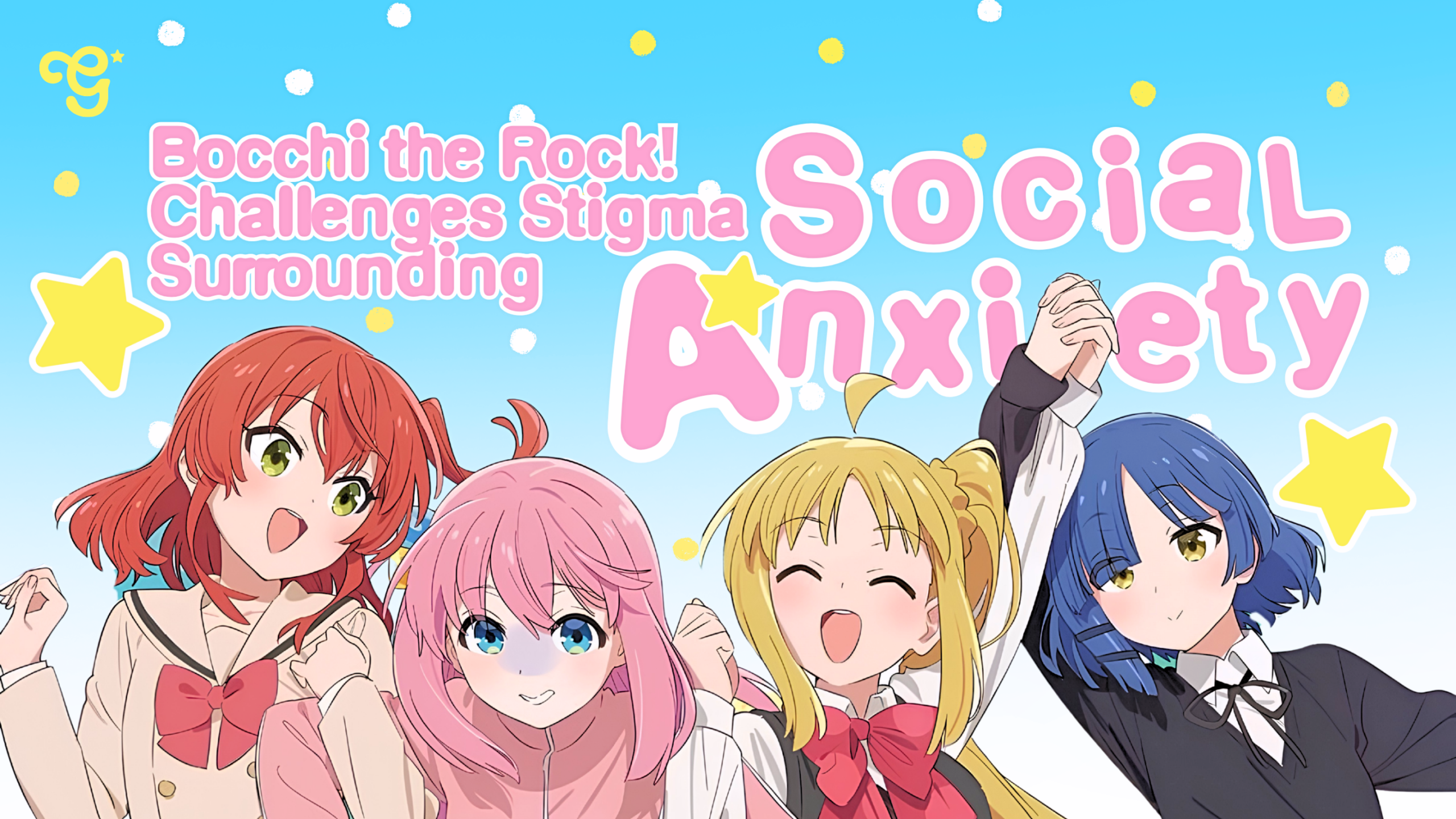
There’s something about a band slice-of-life anime that hits differently, and Bocchi the Rock! is arguably one of the best to be released in recent years. Hitori Gotoh, aka Bocchi, is incredibly skilled at guitar and anonymously posts online to thousands of followers under the name “guitarhero.” Despite Bocchi’s musical talent, her social anxiety disorder keeps her from pursuing in-person performing.
Spoilers for Season 1 of Bocchi the Rock!
Until drummer Nijika approaches her after hearing Bocchi play guitar in a park. Immediately, Bocchi is thrown into the fast-paced world of live music by joining Kessoku Band. IN addition to working at STARRY, the band’s home club owned by Nijika’s sister, Seika. Kessoku Band is rounded out by Ryo, the aloof bassist, and Kita, the lead vocalist and backup guitarist, who is Bocchi’s popular classmate at Shuka High School.
Through the newly formed band’s (mis)adventures, Bocchi portrays social anxiety in the slice-of-life genre without the theme’s heaviness or any mocking.
The anime’s portrayal of social anxiety disorder and breaking the stigma through humor

Nearly 4.5% of people across the globe have some type of anxiety disorder. With social anxiety disorder being one of the most prevalent types. If Bocchi was sitting in front of a mental health professional, she would check off all the boxes on the social anxiety disorder test. She’s constantly scared of humiliating herself and being rejected by not only strangers, but even her friends and bandmates. When outside of the homemade studio in her bedroom’s closet, the world feels all too overwhelming.
“I can’t even enter a convenience store without psyching myself up in advance,” she says at one point. Whether it’s visiting your local 7-Eleven or making a phone call, this is all too relatable if you live with social anxiety.
That said, having a social anxiety disorder doesn’t automatically mean a person is an introvert, and vice versa.

This is best explained when Bocchi notes the difference between her and Ryo. Ryo is routinely called a “loner,” but Bocchi describes herself as lonely. While Ryo is content going to record stores or shops by herself, Bocchi desperately wants to connect with others but struggles. For example, when she tries to talk to her classmates about music, she freezes completely.
Moreover, if you have an anxiety disorder, you’ve almost undoubtedly had someone claim that it’s “all in your head.” However, this is a harmful misconception. The anime does a great job of capturing the dismissed physical symptoms that accompany anxiety, frequently depicting Bocchi as trembling, blushing, and even nauseous. In a dramatized yet silly scene, Bocchi is found hiding in a “Ripe Mangos” box as she first plays guitar with Kessoku Band, an attempt to soothe her unregulated nervous system.
These over-the-top moments in Bocchi don’t come across as ridicule, but as a creative way of representing how it feels to live and cope with social anxiety. You’d probably be hard-pressed to literally find someone hiding in a box in real life. But the feeling of wanting to isn’t far-fetched.
It captures the internal monologue and social anxiety

About 30 to 50% of people have an “inner monologue” or “inner voice.” This can be described as a conversation in your mind, a visual slideshow of pictures, or both. For people with anxiety disorders, this inner dialogue can become intensely critical, leading to anxieties being repeated on a loop.
A significant bit of the anime follows Bocchi’s inner conversations. Mostly centering around ways that she might embarrass herself, ruin her new friendships, or fail at playing live music. She pictures herself on “Loneliness Hill,” where a field of roses wilts anytime she believes her self-growth has stalled.
Since Bocchi is a slice-of-life, her intense insecurities are never portrayed as too clinical. A clever, often cute visual cue for her inner voice is when the anime switches animation styles to show Bocchi spiraling as her anxiety becomes all-consuming.
In contrast, Bocchi shows how she breaks the loop and challenges her inner critic in ways that are grounded in real-life evidence. You can learn to quiet your inner critic by leaning on your passions. Bocchi does this by playing in Kessoku Band. Similarly, a healthy amount of daydreaming can help quell anxiety and boost confidence. Bocchi does this when she envisions herself as a famous rockstar.
Having supportive friends and family can make all the difference

Much of Bocchi’s self-growth should be attributed to her. But her friends and bandmates also play a major role in Bocchi’s self-growth. Living with any mental health condition can be an isolating experience, and lacking a support system amplifies symptoms. Though anxiety disorders are more widely discussed, myths persist. People with social anxiety disorders may be perceived as being weak and are expected to just “get over it.” Of course, anyone with any chronic illness knows this is not how it works.
Rather than judging her, Bocchi’s friends and family are incredibly supportive.
They acknowledge her social anxiety, but still find a balance between challenging her and respecting her boundaries. For instance, Bocchi has to take promo photos with Kessoku Band. But her bandmates don’t press her to create a personal social media account. When her makeshift and drunk music mentor Kikuri Hiroi has Bocchi join her for a street performance, she doesn’t force Bocchi to open her eyes. Instead, she simply reminds Bocchi that she’s “not in combat” with the crowd, which alleviates Bocchi’s anxiety.
It’s made clear that Nijika and Kita are the ultimate extroverts. But they do their best to validate and understand Bocchi. Even when she burns out, turns to ash, and floats away in the wind. Literally.
Even small steps towards self-growth is self-growth

Self-growth is a theme throughout the anime, but I love that Bocchi isn’t miraculously “cured” of social anxiety. She basically spends the whole anime stumbling through small doses of exposure therapy for her social anxiety through her job at STARRY, new friendships, and performances.
For example, Bocchi struggles to make eye contact and have conversations with customers at STARRY; she ducks behind the counter and burns herself with coffee while in anxiety-driven trances. When she successfully does, Nijika congratulates her on having “taken a step forward.” As a shocked Bocchi explains in one of her inner monologues (where she’s depicted as a lone traveler in the desert), the step of looking a customer in the eye feels like a thousand steps for her.
She doesn’t undergo some extreme personality change that would happen to a protagonist in a shonen.
She challenges herself but also learns to recognize when she’s pushing past her personal limits. By the end of the first season, the Bocchi who once played guitar in a cardboard box is now playing at the high school cultural festival and unsuccessfully stage-diving.
It may take a pause, a crash-out, or a good shake from someone for her to snap out of her anxiety loop. But Bocchi keeps pursuing her dreams and friendships despite her social anxiety.