“You will not ‘get over’ the loss of a loved one; you will learn to live with it. You will heal, and you will rebuild yourself around the loss you have suffered.” – Elisabeth Kübler-Ross, renowned psychiatrist
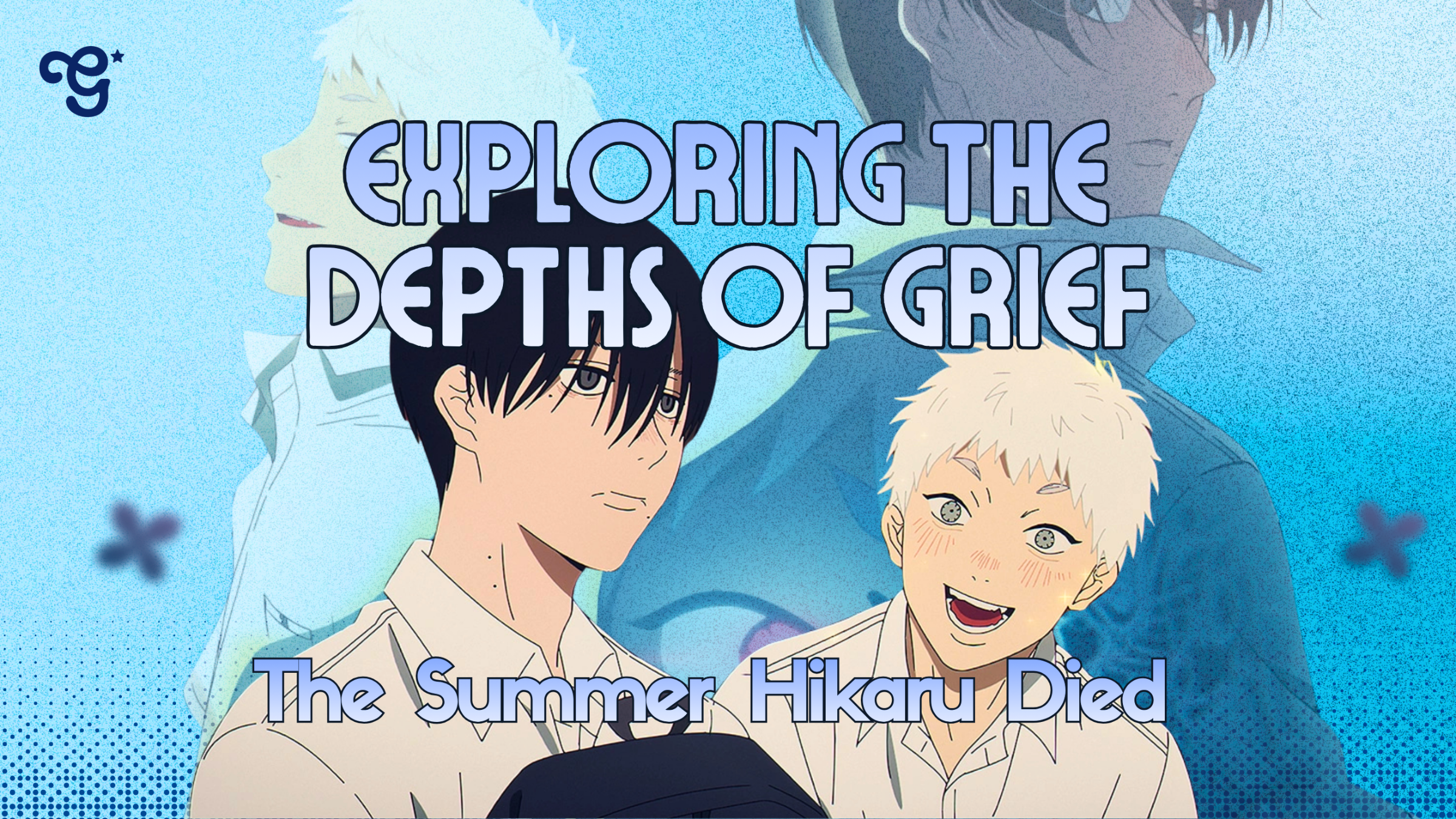
However, what if you actually…don’t have to learn to live with it? Enter Yoshiki Tsujinaka, our grief-stricken protagonist in Momokuren’s The Summer Hikaru Died.
After a tragic accident kills his best friend Hikaru, timid Yoshiki is given a once-in-a-lifetime chance to skip the 5 stages of grief. After finding the body, the infamous monster Nonuki-sama reanimates and takes up residence in the deceased boy’s body. Desperate to keep its human identity, it offers to pass as Hikaru with perfectly replicated mannerisms so life can continue “normal” for everyone. To Yoshiki or anyone grief-stricken, this is the jackpot deal. Maybe not with supernatural monsters involved, but in such a situation, the question must be asked:
Has grief really been avoided, much less overcome? The answer is a resounding “no.” If anything, such a deal would deepen grief so much that the road to acceptance would look nearly impossible. This is the commentary poised in The Summer Hikaru Died. It is a sorrowful tale about a boy who is not only unable to overcome his mourning but ultimately refuses to do so, embracing a false sense of reality.
When it comes to grief, though there are 5 stages, it never unfolds linearly.

Even after years of suffering, most people stay stuck at the precipice of acceptance: the stage of “depression”. This is understandable because reaching “acceptance” requires a persistent willingness to face life’s reality after loss. Unfortunately for Yoshiki Tsujinaka, this is his issue. Before analyzing the questionable mental routes he takes, we must first understand how Yoshiki’s personal life contributes to his mental state and actions.
He is a simple country boy born in a rural village (no AC, good Lord). Yoshiki’s family has always been somewhat ostracized because of their gossip-worthy family dynamic. From childhood to teenhood, Yoshiki has been regarded as a “loner” since he never bonded with any villagers his age except for Hikaru, bright, loud, and the complete opposite of Yoshiki. From what the audience can tell, their “two sides of a coin” relationship ran deep, with Yoshiki wholly glued to the exuberant boy’s side.
Not to mention the heavily implied romantic attraction between the two. (LGBT romance for the win, but also sheesh, another doomed yaoi). Hikaru was basically Yoshiki’s entire world. Imagine when that world shatters into irreparable pieces in the form of the world’s death and being alone, harboring unrequited love and thinly veiled queerness with no emotional support system in a traditional, West-bubbahell-town… who wouldn’t be desperate enough to let a monster assume their loved one’s identity?
Yoshiki’s home circumstances also contribute to both his codependency on Hikaru and his eventual warped handling of the death trauma.

To quickly summarize his family dynamic: it sucks, thanks to his father, Toshinori Tsujinaka. Not that there are worse dynamics—at least no one is physically or emotionally abused—but it borders on toxic. His mother and sister aside, his regard for his father flips between disinterest and dislike. The man has shown mutual disinterest in Yoshiki and the family, and he’s known for volatile outbursts. Additionally, due to his poor communication skills, Yoshiki has to witness a marriage rockier than a rowboat during a tsunami.
With that said, to play devil’s advocate a bit, there is rhyme and reason for his father’s unsavory behavior.
Mirroring his son’s circumstances (minus the walking corpse love interest/bestie part), the man is also grieving Hikaru’s father. Which is painfully ironic. Between his own depression and being unaware of Yoshiki’s Hikaru dilemma, Toshinori is emotionally absent. As the source of a depressing, borderline chaotic household, his father unintentionally instilled in Yoshiki a sad mindset: stay emotionally reclusive to avoid further emotional turbulence. Moreover, when he faces deep heartbreak, he feels he has no one to vent to or help carry his emotional burdens.
Setting aside Yoshiki’s susceptibility to tragic decision-making, the spotlight must now turn to the decisions that further demonstrate his mourning. Yoshiki desires “Hikaru’s” presence despite the harm it causes to himself and the village. Regarding the village, Yoshiki was told that “Hikaru’s” presence is a “lightning rod” for dangerous entities. It would only worsen the longer he stayed. This news shook him. For a while after the revelation, Hikaru fell into emotional turmoil and somewhat distanced himself from “Hikaru”.
Unfortunately, that moral tug-of-war ends with Yoshiki ultimately choosing to jeopardize the village to keep “Hikaru” tethered. The deeper implications of his actions are sad. His grief leads him to consider innocent townspeople, including close school acquaintances, to be of lesser value than his desires.
For Yoshiki specifically, “Hikaru’s” presence causes the most obvious detriment.

The “how” is significant because two narratives demonstrate it. In one, the matter is literal: by being tied to “Hikaru”, Yoshiki jeopardizes his health, life force, and safety. Replica or not, this “Hikaru” is an unknown, alien-esque, eldritch creature with cannibalistic greed and a penchant for murder. The creature confirmed this itself—and some unsavory encounters Yoshiki and villagers had are exemplary. Not only does “Hikaru’s” presence make Yoshiki a target for other dangerous supernatural entities, but it also harms his sanity and humanity. Despite paranormal expert Rie Kurabayashi’s warnings and his own common sense, Yoshiki cannot detach from the grief driving him to want “Hikaru.”
The second narrative is allegorical. Yoshiki’s desire for “Hikaru” shows how he is purposely trapping himself in a never-ending loop of non-acceptance.
As stated before, one may think it’s a blessing to be given a clone of a deceased loved one. Until you realize you never actually addressed your emotional trauma. Yoshiki was unfortunate to witness the real Hikaru’s lifeless body and be the sole bearer of the knowledge of his death. To add to this burden, only seven days passed before the monster came to the village as “Hikaru”, and Yoshiki, still in the grief stage of “disbelief”, hid two truths.
Fear was the main reason Yoshiki stayed quiet, but even with the revelation, he could never truly distance himself from the monster. The “why” doesn’t need to be asked; he realized “Hikaru” could be his way to avoid dealing with the real one’s death. Yoshiki and the first episode establish this when he tearfully says, “Hikaru’s gone, that ain’t gonna change. So even if it’s a fake, I want him to stay.”
Yoshiki may say he knows the monster isn’t truly his friend. But his broken heart still sees it as a suitable replacement.

“A way to heal,” it thinks, when really it’s like picking a scab on a wound each time it forms. So yes, one could say Yoshiki found a “get out of grief free” card, but it’s as real as a monopoly dollar. He never properly grieved the loss of the true flesh-and-blood Hikaru before playing house with a monster, and he specifically doesn’t want to.
The final scene of the season further emphasizes this sentiment. It brings this overall analysis full circle: Yoshiki, with genuine conviction this time, decides he wants “Hikaru” to stay. In the iconic beach scene, “Hikaru” himself acknowledges that his presence has exacerbated Yoshiki’s mental health decline and stopped him from accepting reality and the real Hikaru’s death. He declares that he wants to separate from him for the benefit of everyone, himself included, and return to the ghostly mountains.
In stark contrast, Yoshiki immediately descends into despair.

In a fit of desperation, he goes so far as to grasp at “Hikaru” on his hands and knees as he pleads and guilt-trips the “boy” into staying. Moreover, in the middle of this climactic, tear-riddled moment, Yoshiki finally says the quiet part out loud: “I’m desperate. At the end of the day, I’m doing this all for myself.” After many episodes/chapters of depression, jeopardizing himself and the village, second-guessing his choices, and guilt and resentment toward himself for making said choices, he finally acknowledged that he only wants Hikaru for the “betterment” of his life. This acknowledgment also reveals that Yoshiki would even manipulate “Hikaru” if it meant their life could remain “normal”. When Yoshiki gave the whole Shakespeare monologue to persuade him into believing that he wants “Hikaru” as “himself”, that manipulation was evident.
As sad as these actions are, they make perfect sense.
Regardless of morality, who could look at a clone of their loved one and not project onto it? “To let go of ‘Hikaru’ is to experience his death twice,” is what his heart woefully thinks–and strives against. And so, it is with this scene that the narrative of Yoshiki’s self-destructive walk with grief is evident. He never truly grieved and accepted the real Hikaru’s death. “Hikaru” entered his life as a way to skirt that necessary process. Thus, Yoshiki would choose to live in a pitiful, false sense of reality.
Much like Sui Ishida of Tokyo Ghoul (can you tell I really like Tokyo Ghoul?), mangaka Momokuren is truly one of the masters of tragic storytelling. Expertly capturing the essence of horror/suspense and combines it with relatable themes of death and loss. He gives the world The Summer Hikaru Died and Yoshiki, a tragic child suffering from an endless loop of depression. The narrative is respectful, too, in how carefully it avoids condemning or promoting the protagonist’s morally questionable actions. The Summer Hikaru Died is truly a gemstone of a read!