Death Note is a story obsessed with moral complexity. It is constantly asking questions about justice, power, guilt, and who gets to decide what another person deserves. And yet Misa Amane is repeatedly turned into something much easier to consume than a person. She is a face, a body, a girlfriend, a weapon, a suspect, a joke, a plot device.
That contradiction starts with the way the story presents her.

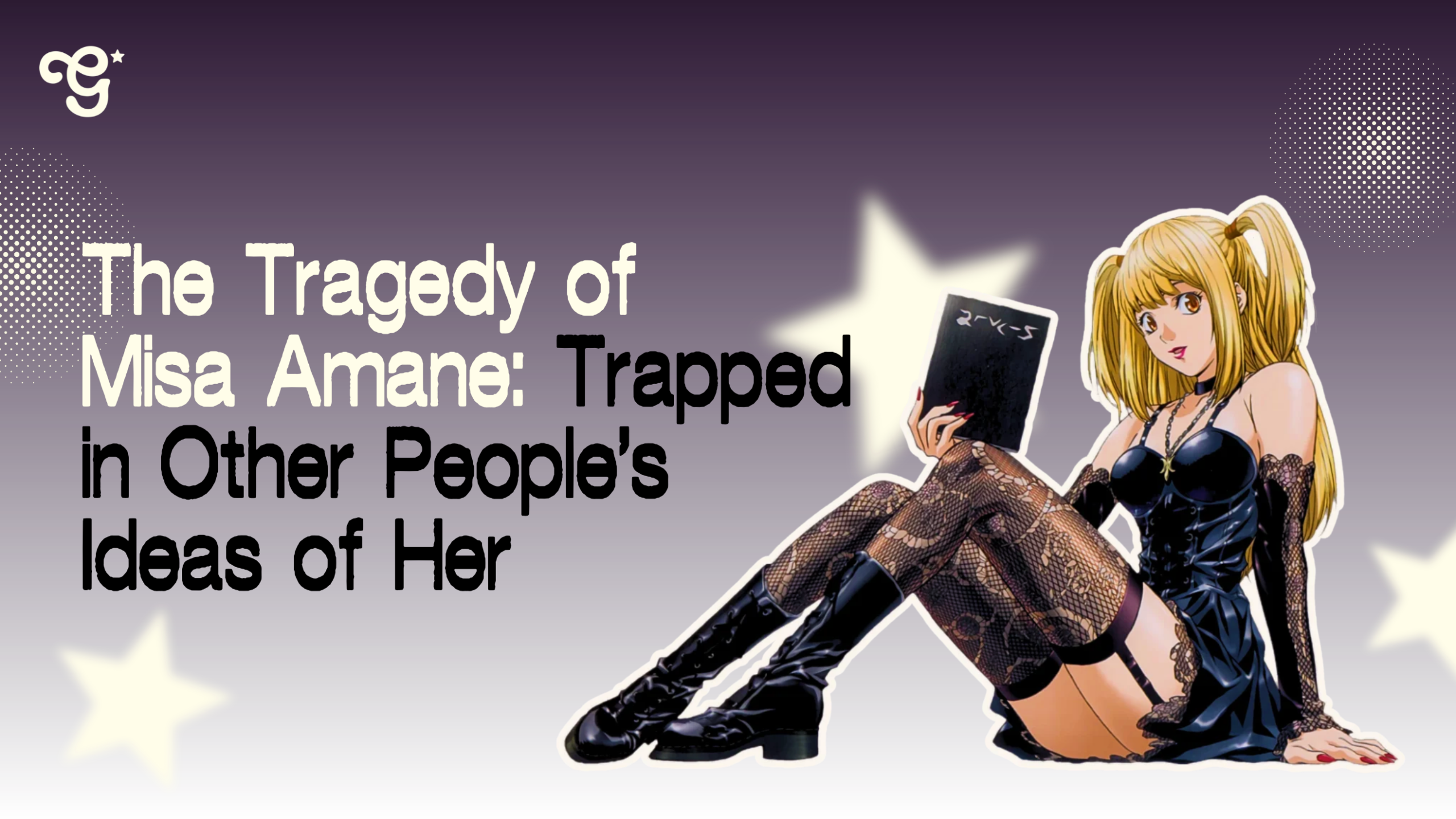
Misa is one of the most recognizable characters in Death Note. From the pigtails and Gothic fashion to the exaggerated sweetness of “Misa-Misa,” and almost everything about her feels immediately readable. She is emotional where Light is controlled, dramatic where L is detached, and completely open about what she wants in a story full of people constantly hiding what they think. Yet there is grief, violence, fame, devotion, and loss sitting underneath that image. Her parents’ murder becomes the reason she loves Kira. Gelus dying to save her becomes the reason she receives the Death Note. And, the Shinigami Eyes turn years of her future into a power the plot can use. We understand what these experiences allow Misa to do, and what they allow other people to do through her, much more clearly than we understand what living through them actually does to Misa.
By the time Misa Amane meets Light, Kira is already tied to her parents’ murder, the punishment of the man responsible, and her own ideas of justice and gratitude. Misa sees the person she believes avenged her family. Light sees another Death Note, the Shinigami Eyes, the access her celebrity gives him, complete loyalty, and a Shinigami willing to protect her. Her Eyes become information, her fame becomes access, her devotion becomes obedience, and eventually even Rem’s love becomes leverage.
But usefulness gives Misa something emotionally valuable too.
If Light needs her, then he has a reason to keep her. She cannot make him love her, so becoming necessary starts to offer a kind of security instead. Misa is imagining romance, jealousy, marriage, and a future together. Light however, is measuring what she can still do for him. Making their relationship feel like two completely different stories happening in the same scenes.
And Misa keeps giving pieces of herself to stay inside hers. She gives away years of her life for the Shinigami Eyes and loses access to parts of her own memory. The sad part is that she is not completely unaware that Light uses her. She knows enough to understand that his affection is conditional, but being needed can start to feel dangerously close to being wanted when being wanted is what you are desperate for.
Her memory loss makes that pattern even stranger. When Misa gives up ownership of the Death Note, Light, the investigators, and the audience continue knowing things about her that she can no longer remember. For a character who is already constantly interpreted from the outside, there is something almost cruel about everyone else having greater access to a version of Misa than Misa herself.
Rem’s death pushes the same idea even further.

Rem loves Misa enough to sacrifice herself. Light realizes that love can be used to eliminate L, and one of Misa’s closest relationships becomes another mechanism in his plan. For Light, Rem’s death is victory. For Misa, someone who loved her enough to die for her is simply gone. The story is far more interested in everything that death accomplishes than in what the loss leaves behind. Even outside the story, Misa was partly created around something Light would never do himself.
In Death Note 13: How to Read, Tsugumi Ohba discusses wanting a cute female character in a cast dominated by men. While Misa Amane also solves a practical problem because Light would never sacrifice half of his own lifespan for the Shinigami Eyes. Someone else had to be willing to pay that cost. Misa obviously becomes more than a solution to a plot problem. Howerver, it is hard to ignore how often the story asks her to carry the things its protagonist will not.
The way those scenes are framed makes that imbalance easier to accept than it should be. Misa is one of the most visible women in Death Note, but visibility is not intimacy. The story looks at her constantly without necessarily bringing us closer to her. The framing emphasizes her body, clothes, expressions, sexuality, and exaggerated reactions while people around her often treat her as childish enough to be handled by someone else. She can dominate a scene without controlling what the scene asks us to notice. Her body and reactions receive attention while her perspective rarely organizes what is happening in the way Light or L’s does.
Misa Amane’s femininity becomes part of that problem because it gives her real power while also making her easier to dismiss.
Her beauty and celebrity give her access, and Misa-Misa gives her a public identity people immediately recognize. Yet the same femininity that makes her valuable can also become proof that she is shallow, childish, decorative, or unserious. Misa is allowed to benefit from being desirable without necessarily being respected for understanding how desirability works.
There are also moments where other characters speak to Light as though Misa is his responsibility to control. Even when she is standing right there, positioning him as the reasonable person and Misa as the problem he has to manage. Everyone has a version of her. Light sees a tool. The investigators see a suspect. The public sees Misa-Misa. The story often sees a source of comedy.
Misa herself gets much less room to decide which version should matter.

That imbalance becomes easier to overlook because Misa is funny. She is jealous, clingy, dramatic, impulsive, and sometimes genuinely ridiculous, while Light’s exhausted reactions become part of the joke. The more the story establishes Misa as difficult or unserious, the easier his coldness becomes to read as understandable frustration instead of cruelty. He lies to her, uses her loyalty, benefits from her sacrifices, manipulates her feelings, and gives her far less than she gives him. And yet, the dynamic can feel less like “Light is exploiting someone who loves him” and more like “look at what Light has to put up with.”
What makes that more obvious is how much ridiculousness Death Note allows its male leads without taking away their seriousness. L barely behaves like a normal person. Light becomes so convinced of his own superiority that mass murder becomes part of his idea of justice. Those qualities make them more fascinating rather than easier to dismiss.
Misa’s foolishness works differently.
She is not secretly a genius on their level, and she does not need to be. But she is perceptive enough to find Kira, manipulate Higuchi through the version of herself he wants to see, and understand how attraction can be used. Light reading someone’s desires and exploiting them is strategy. Misa doing something similar rarely stops her from being remembered as the dumb girl in the room.
There is something strange about what Death Note decides is worth taking seriously. Light wants to become a god, reshape society, kill anyone he believes stands in his way, and prove that his judgment should determine who deserves to live. The story spends enormous amounts of time sitting inside those desires. Misa wants Light to love her. That desire is obsessive, unhealthy, and tied to terrible choices. But, it is also much easier to turn into a joke.
And it is not as though her devotion comes from nowhere. Misa Amane has already lost her parents, nearly been killed herself, been saved by a Shinigami, and attached Kira to both revenge and gratitude before Light ever enters her life as a person. None of that makes her innocent. She supports Kira, kills people, threatens others, and chooses Light repeatedly.
That matters because the audience can start inheriting the same version of Misa everyone else does. Light and L’s battle is one of the most entertaining parts of the story. The audience is invested in the traps, deductions, lies, and constant shifts in advantage between them. Misa complicates that rhythm. She interrupts Light’s plans and demands his attention. Misa behaves unpredictably, and creates problems he has to solve. The more invested we become in watching him and L outthink one another, the easier it becomes to experience Misa the way Light does.
When she helps, she is useful; when she makes things harder, she is annoying.
Comedy makes that alignment feel harmless. We laugh when Misa clings to him, laugh at his exhaustion, and laugh at how completely their ideas of the relationship fail to match. Even though part of the joke depends on us knowing something painful that Misa refuses to fully accept: Light does not love her. We are watching her humiliation from the side of the person humiliating her. Misa’s devotion looks ridiculous long before it looks painful.
That is how “annoying girlfriend” becomes one of the easiest versions of Misa Amane to remember. The pigtails, Gothic fashion, jealousy, dramatic declarations, and constant interruptions are all real parts of her, but they become much easier to carry away than everything sitting underneath them.
The audience ends up doing something very similar to the characters around her. We take one recognizable version of Misa and let it explain the rest.

Misa complicates that reading herself because she is not simply trapped inside other people’s ideas of her. She supports Kira, kills people, threatens others, chooses Light repeatedly, helps create Misa-Misa, and understands enough about the way people see her to sometimes use those assumptions herself. But creating a role does not mean controlling what everyone else decides that role means. Misa can perform Misa-Misa without Misa-Misa becoming a complete explanation of her, just as she can know Light is using her without making their relationship any less unequal.
Her ending is where those versions of Misa finally start falling away. Rem is already gone, Light dies, and there is no Kira left for the Second Kira to follow. The girlfriend loses Light, the weapon loses the person using it, and the Second Kira loses the Kira she built that identity around. After an entire story spent defining Misa through what she means to everyone else, this should be the moment where we finally see what remains when those roles stop being useful.
Instead, that is almost exactly when Death Note stops looking at Misa Amane.
For most of the story, Misa is impossible to ignore: loud, beautiful, funny, irritating, useful, dangerous, and constantly being watched. Then the people who gave those versions of her meaning disappear, and so does much of the story’s interest in who she might become afterward. For once, nobody tells us what Misa is useful for or what she is supposed to be. Instead of finally letting us know who Misa Amane is, the story leaves her there.