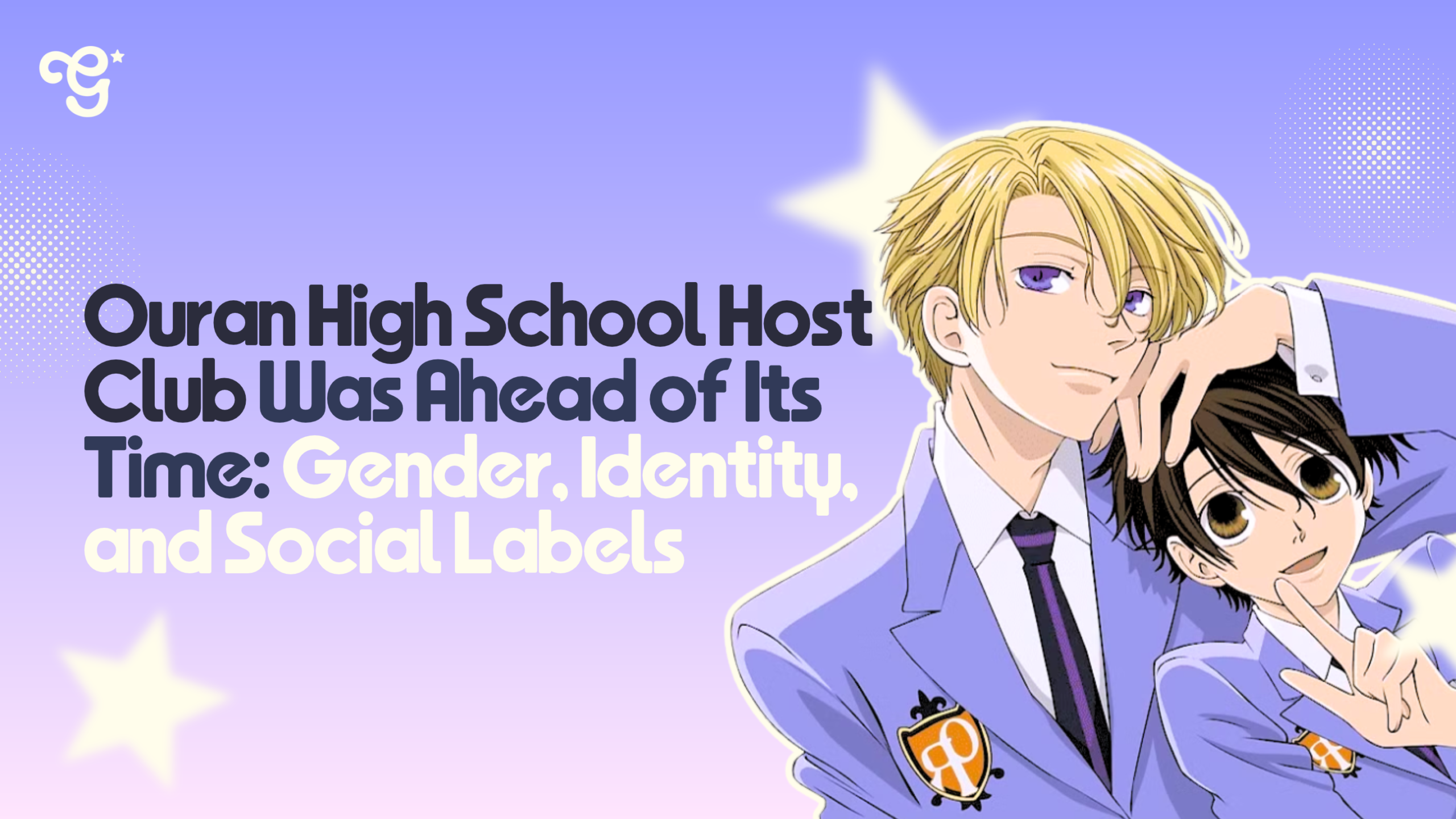
Ouran High School Host Club is remembered for its roses, dramatic entrances, elaborate costumes, romantic archetypes, and wonderfully over-the-top world. The characters seem easy to understand the second they appear. Tamaki is the prince. Kyoya is the cool one. Mori is strong and stoic. Honey is cute. Hikaru and Kaoru are the twins. Each person becomes a type, and each type comes with a performance that both the customers and the audience already know how to read. Once Haruhi enters the picture, the illusion starts to crack.
Ouran High School Host Club and Its Progressive Approach to Gender

That becomes even more interesting when you remember when Ouran came out. The manga began in 2002, and the anime followed in 2006, long before today’s everyday language around gender expression, masculinity, and identity became mainstream. Shoujo media had already spent decades playing with beautiful boys, cross-dressing heroines, princely women, queer desire, and gender ambiguity, so Ouran was not inventing these ideas. What it did especially well was take those familiar conventions and start asking what happens when they stop being useful for understanding an actual person.
Haruhi Fujioka Challenges Traditional Gender Roles and Expectations

Haruhi is interesting because she walks into a room where everyone has made themselves legible through recognizable types, and she refuses to fit neatly into one. The Host Club initially reads her as a boy because of her short hair, clothes, posture, and mannerisms. When they learn she is a girl, that information should, theoretically, resolve the misunderstanding. Instead, it reveals how many other assumptions they had attached to it. Haruhi can look handsome in the uniform and feminine in a dress. Girls can be attracted to her. Boys can fall for her. She can move comfortably among traits the people around her read as masculine or feminine without treating those shifts as transformations of who she is.
What I find striking is that Haruhi rarely feels compelled to resolve that ambiguity for anyone else. She does not reject being a girl, nor does she present masculinity as some truer identity hidden underneath femininity. She does not treat every gendered choice she makes as evidence that must add up to a larger explanation of herself. A haircut can be a haircut. A uniform can be convenient. A dress can be something she wears without suddenly becoming a different version of Haruhi.
Gender Expression Doesn’t Define Identity

That distinction matters, because Ouran doesn’t suggest that gender itself is meaningless. Rather, Haruhi exposes how much information people assume they can extract from it. Knowing Haruhi is a girl tells us something true about her. Still, it doesn’t automatically tell us how she will dress, what she will enjoy, how she will behave, who will find her attractive, or which roles she will feel comfortable occupying. The mistake isn’t recognizing her gender, but expecting that recognition to explain the rest of her.
What makes this especially clever is that Ouran is not simply showing other characters misreading Haruhi. It is setting the audience up to do the same thing. The series knows how quickly we turn appearance, behavior, and genre conventions into conclusions about who a character is supposed to be. So it gives us those signals, lets us feel confident in what they mean, and then changes the context without changing Haruhi. Again and again, the joke isn’t that Haruhi has become something different, but that the meaning we assigned her was never as stable as we thought. The show keeps handing us labels, waiting for us to trust them, and then showing us exactly how much we invented after the label was attached.
Honey and Mori: Contrasting Representations of Masculinity

Mori and Honey move the question from how masculinity is read to how it is enforced. Mori fits a familiar masculine ideal so comfortably that nobody asks him to explain it: tall, restrained, protective, physically powerful. Honey’s love of cake, Usa-chan, and cute things attracts a different kind of attention because those preferences are treated as things a boy might eventually need to grow out of.
Honey’s martial arts background makes that pressure harder to ignore. He comes from a world where strength and masculinity are already tied together, and where the parts of himself that seem too cute or childish are treated as things he should eventually leave behind. His family does not just misunderstand those interests; they expect him to suppress them and present himself in a way they consider more appropriate for someone with his martial arts background. Psychologists sometimes describe masculinity through the idea of precarious manhood: something that has to be continually proven and can be called into question when a man strays too far from what masculinity is supposed to look like. Honey’s story pushes directly against that pressure. His strength does not prove that the cake, the affection, or Usa-chan were misleading. It proves they never needed explaining away in the first place.
He remains obsessed with cake. He keeps Usa-chan. And he stays affectionate and openly cute. Ouran never makes him trade those things for the right to be taken seriously. The pressure to choose existed; Honey refuses to choose.
The Zuka Club Turns Traditional Gender Roles Upside Down

Tamaki takes gender performance somewhere else entirely. His prince persona is obviously constructed. He knows when to turn on the charm, when to make the grand gesture, when to become exactly the kind of romantic fantasy the Host Club’s customers came to see. But the interesting part is that the performance is not fake. Tamaki really is theatrical, generous, emotional, romantic, needy, and sincere. The club does not invent those qualities. It takes something real and makes it legible.
That complicates the idea that performance means pretending. Sometimes the version of ourselves that other people recognize most easily is still genuinely ours. The problem begins when that readable version becomes the only version anyone expects to see. Tamaki can be princely without “the prince” completely explaining him. Honey can really be cute without “cute” explaining him. A role can be authentic and still become restrictive once everyone starts treating it like the whole person.
The Zuka Club and the Performance of Gender Roles

The Zuka Club makes that construction easier to see because it changes who is performing it. Its women take on the princely role, pursue women, charm them, protect them, and become the people those women swoon over. At first glance, the obvious difference is that women are performing masculinity. But Tamaki is performing masculinity too.
That is what makes the comparison so useful. The Zuka Club does not suddenly turn “the prince” into theater. It exposes the theater that was already there. Tamaki’s version feels more natural because audiences are used to seeing a man in that role. Put a woman in the same position and suddenly the gestures become visible: the confidence, the clothes, the language, the posture, the romantic choreography. None of those things became performed because a woman picked them up. We became more aware of the performance because the person doing it changed.
Ouran keeps using that shift in perspective to make familiar things look strange again. Masculinity stops feeling like something men possess and starts looking like something built through recognizable gestures, roles, and expectations. Femininity works the same way. The series is not arguing that those performances are fake. It is showing how much repetition it takes before a performance starts to feel natural.
Ouran’s Queer Themes Go Beyond Its Male-Male Pairings

That same looseness carries into attraction. The girls visiting the Host Club know what they want. They choose hosts, develop preferences, and enjoy specific fantasies. Hikaru and Kaoru deliberately exaggerate male-male tension because their customers enjoy watching it. Girls respond to Haruhi while reading her as male. Women desire the princely women of the Zuka Club. Ouran keeps showing attraction happening before everyone has neatly sorted appearance, gender, role, and desire into matching categories.
That is what makes its LGBTQ+ themes more interesting than simply counting queer-coded moments. The series rarely treats desire as something that needs a perfectly organized explanation. People are attracted to beauty, presentation, fantasy, chemistry, and personality, and sometimes those things refuse to line up cleanly.
Representation of Gender Nonconformity Through Ranka

Ranka brings that same logic into Haruhi’s home life. His femininity and cross-dressing are part of who he is, but the story doesn’t treat them as a problem to solve before he can be Haruhi’s father. He loves her, worries about her, embarrasses her, and takes care of her. Haruhi grew up around someone whose presentation already challenged the neat connections other characters keep trying to make, which helps explain why she is so much less invested in those rules herself.
Haruhi and Kyoya: Two Sides of Ouran’s Class Commentary

Class gives Ouran another way to show what happens when a category becomes an explanation. Haruhi enters the school with less money than almost everyone around her, and “commoner” quickly stops being a financial description and starts becoming a personality in the boys’ heads. Ordinary groceries, food, shopping, and everyday experiences become fascinating because they belong to Haruhi’s world rather than theirs. They don’t just notice she has less money. They start expecting that fact to tell them what kind of person she is.
Kyoya has the opposite problem. His wealth, family name, intelligence, composure, and competence make him look like somebody who has everything figured out. The “rich genius” label is easy to admire and easy to stop at. It hides how much of Kyoya’s life is tied to achievement, usefulness, family expectation, and proving his place inside a hierarchy he did not create.
That is what makes Haruhi and Kyoya such an interesting pair. Haruhi gets reduced to what she lacks. Kyoya gets reduced to what he possesses. Their lives are obviously not equivalent, but class distorts how both of them are read. Haruhi’s lack of wealth becomes assumptions about simplicity, innocence, and unfamiliarity. Kyoya’s wealth becomes assumptions about control, ease, and competence. In both cases, money stops describing circumstance and starts pretending to describe character.
Hikaru and Kaoru’s Struggle to Be Seen as Individuals

The twins take that problem a step further because their label shapes not only how other people see them. It starts shaping how they understand themselves.
Hikaru and Kaoru really are twins. They look alike. They are close. And they deliberately turn that closeness into something the Host Club can sell, and everyone is happy to stop there. Their sameness becomes entertaining, recognizable, and profitable.
That is what makes their struggle with individuality more complicated than simply learning which twin is which. When everyone has treated you as one unit for long enough, sameness can stop being something other people project onto you and become something you perform back to them. Their shared identity is real, but it is reinforced every time people enjoy them most when they remain “the twins.”
That feeling extends far beyond twinhood. People get assigned roles inside families, friend groups, schools, and workplaces all the time: the responsible one, the smart one, the difficult one, the funny one, the successful sibling. A label may begin with something completely true. But once everyone expects you to keep being that version of yourself, the label can start shaping what you think you are allowed to become.
Haruhi does something deceptively simple with Hikaru and Kaoru: she keeps looking. She notices differences after the category has already given everyone else a convenient answer. She sees two people without needing their twinhood to disappear. The label doesn’t have to be false to become limiting.
Why Ouran High School Host Club Still Feels Relevant Today

None of these descriptions are actually wrong. Haruhi is a girl. Honey is cute. Tamaki is theatrical. Hikaru and Kaoru are twins. Kyoya is wealthy. The problem is what happens when a description starts doing the work of an explanation.
And the Host Club was never just a backdrop for that idea. Its whole setup exaggerates the way society already works: people become easier to understand once they are turned into recognizable types, and those types come with expectations about how they should look, act, desire, and belong.
That feels especially relevant now. So much of public life is built around quickly sorting people. Culture-war debates turn gender, sexuality, class, race, politics, family roles, and even hobbies into signals of what someone supposedly believes about everything else. Social media makes that sorting even faster. A few posts, an aesthetic, a phrase, a relationship, or a political opinion can become enough for strangers to decide what kind of person they are looking at and what else they must believe.
Ouran’s Themes Reflect Modern Society

The categories themselves are not the problem. Many of them describe real identities, experiences, inequalities, and communities. The trouble starts when they become shortcuts for everything we have not bothered to learn.
That is what Ouran keeps exposing. People are more complicated than the roles society gives them, but society keeps rewarding those roles because they’re easy to recognize. The show makes that contradiction funny enough to watch, but the world outside it keeps proving how serious it can become.
Maybe that is why Ouran still feels so sharp. The language has changed, the platforms have changed, and the arguments have gotten louder. But the instinct underneath them is familiar: see the label, assume the rest. The show’s real challenge is whether we can resist doing that long enough actually to see the person.