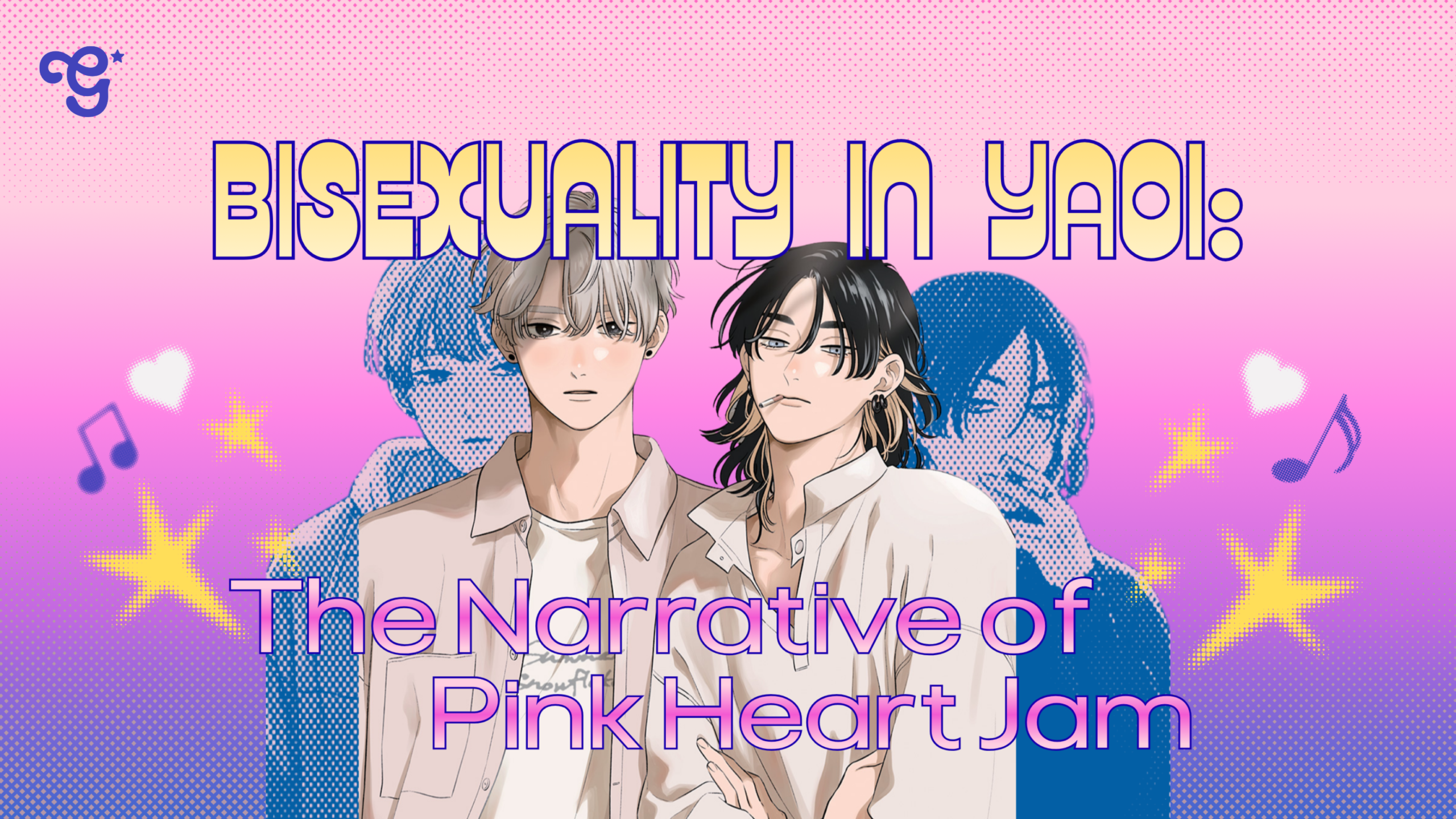
Love. Straight love, boy love, girl love- we love to see love in all its forms. After all, it’s the highest-grossing genre for a reason. With that said, despite how popular romance is, there is still an unsurprising neglect of a specific section of the spectrum: Bisexual love. One would think that after dances advocating for diversity in sexuality, support for bisexuality would be an obvious given…right? Wrong. But, just as the world was suffering a bi-love drought, romance mangaka Shikke appeared. Giving water in the form of a queer-romance lover’s hidden gem, Pink Heart Jam.
Bisexuality has always gotten the short end of the stick in both real and fictional life. Due to most people’s misunderstanding of sexual fluidity, the orientation is victimized by marginalization and tasteless stereotypical portrayals. Hello “chaotic super-sexual flip-flopper.” When it comes to fiction especially, bisexuality suffers from the stereotypes the most, or is often excluded altogether. While Pink Heart Jam is marketed as a boy’s love story, Shikke expertly writes about a boy named Yuki Haiga and his journey of sexual self-discovery and bisexual acceptance. Now, enough with the monologuing. Let’s start pointing the big finger-wand at all the things Pink Heart Jam does right for the community!
(P.S. If you’re a fan of Given, you’re morally obligated to give this story a read!)
Confirmation of the MC’s Attraction to Both Sexes

Fulfilling the basic requirement of sexuality, Haiga has had a confirmed romantic association with a woman. In the scene where Haiga talks with Kanae about his relationship history, he reveals that it originally began with a woman. He’d been in a relationship with a “clingy girlfriend who just wouldn’t let [him] break up with her.” And he ended up romantically involved with his guy friend, whom he had confided in at the time. Definitive introductory proof of his sexuality? Confirmed. Although Haiga’s heteroromantic association did not end well, he never invalidates his attraction to women. He also never speaks ill of them (as most stories would tend to do). Haiga’s character is simply put. He has a desire to explore his sexuality, and Kanae and his old friend are males who caught his interest.
Shikke’s portrayal of women in this story positively shapes its theme. Usually in romantic fiction, especially in yaoi, female competition is either rudely dismissed or depicted as antagonists. But luckily, none of that exists in Pink Heart Jam. Addressing the ex-girlfriend first, she may have been called “clingy”, but she wasn’t painted in a disrespectful light. Think about how nearly all exes of all sexualities weren’t the most enjoyable people (they’re exes for a reason, yah?). Then there’s also Ami, who was the actual female love rival. Although the “rival” part is used very generously for how fruitless it was. She is not villainized or portrayed as a homophobic/annoying obstacle in the story. She is characterized as a sweet girl with a massive crush on Haiga. An author’s kindness done unto the women.
Dismantling the “Bisexual’s Confusion” Cliche
If bisexuals had a say in romance stories, they’d probably want to eliminate the idea of being “confused.” In the negative sense, at least. The orientation is pigeonholed as “a phase” that they’ll “grow out of.” Or, that they “aren’t really attracted to both boys and girls”. Bisexual people can indeed feel that way. But let’s clock the fact that the confusion only exists because society has heavily stigmatized queerness. It’s never truly been the case that they cannot choose between the two sexes–they simply like both. If someone was asked what their favorite dessert was, and they answered with two things, no one would question it. The logic is as simple as that. Gratefully, Shikke understands the logic, and it’s shown through how Haiga perceives his identity.
However, Haiga indeed says he’s “confused” in the beginning

During his first gay experience, he was all for physicality until the idea of sex (with him as a potential bottom) arose. Overtaken with hesitation, Haiga assumed that invalidated his bisexuality. But then it’s revealed that his feelings stemmed from his reluctance to be on the receiving end of a sexual encounter. It was not the gay sex or attraction itself–and that’s the distinction. Being new to gay culture, Haiga wasn’t aware of certain aspects. Like how it’s normal to have a position preference. A fact supported by Ryo Kanae, the story’s male love interest/future boyfriend, who specifically labels himself a “bottom” in response. Thankfully, with that little clarification and personal soul-searching, he comes to understand that regardless of position preference, his sexuality is a biological matter, and he inherently likes both sexes.
Haiga’s confusion was never meant to invalidate his bisexuality. There is his journey to Ni-choume. Ni-choume is an established hub and safe space for all LGBT+ existences. Its red-light district-esque nightlife is almost strictly for the queer world–so why was Haiga so willing to go there with no issue? He answered that himself when, on the very first panel showing him in Ni-choume, he literally thinks “I’m curious. This could be a chance for me to explore my sexuality more.” The boy knows he’s the human equivalent to a see-saw (in a good way!).
Depicting Positive Queer Acceptance

In a world hanging onto the remnants of stifling religious sexual traditions, internal resistance to one’s queer identity is an extremely common circumstance in queer fiction. It’s completely relatable and needed too. You couldn’t even measure the sacrifices queer folk have had to make for the sake of social conformity. With that said, it’s just refreshing to see a queer individual who doesn’t have internalized homophobia. He walks into his identity with eagerness. But this sentiment by no means invalidates those who were and continue to be unfortunately forced to live in hiding. But rather it’s a sentiment borne from general happiness at seeing a positive experience instead.
Shikke depicts the positive queer acceptance through multiple ways.
First, is through the aforementioned first gay relationship that Haiga had. Based on how he framed the memory, it was an enjoyable experience and a smooth transition into queerhood. Secondly, and most importantly, is his pursuit of Kanae and his willingness to do so. When he first laid eyes on the aloof musician, it awakened a desire in Haiga that didn’t leave even after being told Kanae was a man (If anything, it got stronger!).
Throughout the story, Haiga would also repeatedly have thoughts about how to get closer to Kanae, saying “I just want to talk to him” or “I want to get to know him”, and falling for the boy seemingly early on. This, of course, all culminates in the (passionate; steamy, even) scene that readers had been awaiting, in which the lovestruck boy confidently confesses his love.
Note that Haiga never backtracked or second-guessed his attractions or desire for Kanae; he accepted it as a normal part of his identity (in which it was).
Aside from Haiga, even the friends around them are examples of positive queer acceptance, but external. Though none of their club or band camp members ever make such declarations, their actions do an even better job. When Kanae confides in club-member Hayashida about the latter’s romantic dilemma over Haiga, he does not act with disgust over the gay revelation. If anything, he glazed over that aspect entirely to focus on the realization that Kanae even had a romantic capacity to begin with. Then there’s the demeanor of their friends during Kanae’s graduation and the duet concert the lovebirds shared.
At the graduation, Haiga openly gawks and fawns over the suited-up Kanae (he did look hot as hell), and at the concert, you don’t even have to imagine how diabetically sweet that went. And their friends? Of course they joked about how simp-y Haiga acted, but they genuinely reflected on the boys’ relationship with fondness. Not a single instance of anti-LGBT reaction anywhere–and one of them even cried over how much of a romance movie they act like. See how Shikke normalizes both queer acceptance and bisexual acceptance? It was always that easy.
Cultured Portrayal of Sexual Experimentation
Let’s revisit the negative conceptions about sexual fluidity. Alongside the people who invalidate bisexuality/bicuriousness in general, there are, ironically, the people who view individuals of those natures as the most promiscuous of the LGBT+. The bi population has always been accused of being monogamous-avoidant. And that they only view their partners/sexual encounters as disposable pathways for sex. It’s baffling that people even consider this a truth, when promiscuity has never been limited to a singular sexuality.
Fortunately, this is a belief that Shikke directly challenges with Haiga’s approach to sexual exploration.

Despite having the intent to “explore [his] sexuality” in Ni-choume, Haiga certainly had no intention to sleep around or have orgies to “figure himself out.” Much less sleep around at all. (At the time he met Kanae, he was as virgin as a mocktail). Even at a brothel and Kanae being a sex worker, Haiga specifically stated “I didn’t come here for that kind of service” and “I didn’t hang out this long hoping to get some.” His whole intent was to gain points of sexual reference and find more people who could help him understand himself better. Moreover, throughout the story, Haiga’s person of interest is Kanae only. As such, it’s clear Haiga respects Kanae as a person, and never views him as a sex toy to explore his curiosity.
To really drive home the point that Shikke gives readers a respectful depiction of sexual experimentation in bisexuality, they give us the subplot involving Kanae’s co-worker, Maki. After Kanae suddenly tells Haiga to stop visiting him at the brothel and seemingly cuts ties with him, Haiga is allowed to experiment with the other man. Said other man was quite persistent as well, but Haiga was resolute in his affections for Kanae. Moreover, not only did Haiga turn down Maki’s every advance, but he was written as visibly uncomfortable (borderline disgusted too) at being hounded on. As short-lived as this conflict was, its inclusion served its purpose by showing how Haiga’s character is not written to portray the “promiscuous bisexual” stereotype.
Final Thoughts
This weeb-sertation was a lot of classy words put together to explain how Pink Heart Jam is really the bee’s knees of bisexual fiction. Even though it’s put into the Boys Love category, the fact that the mangaka takes into consideration the bisexual struggle and successfully portrays the sexuality with due respect and understanding is beyond appreciated. Truly a massive W for the queer and specifically bisexual community–now stay tuned for the sequel, Pink Heart Jam Beat.