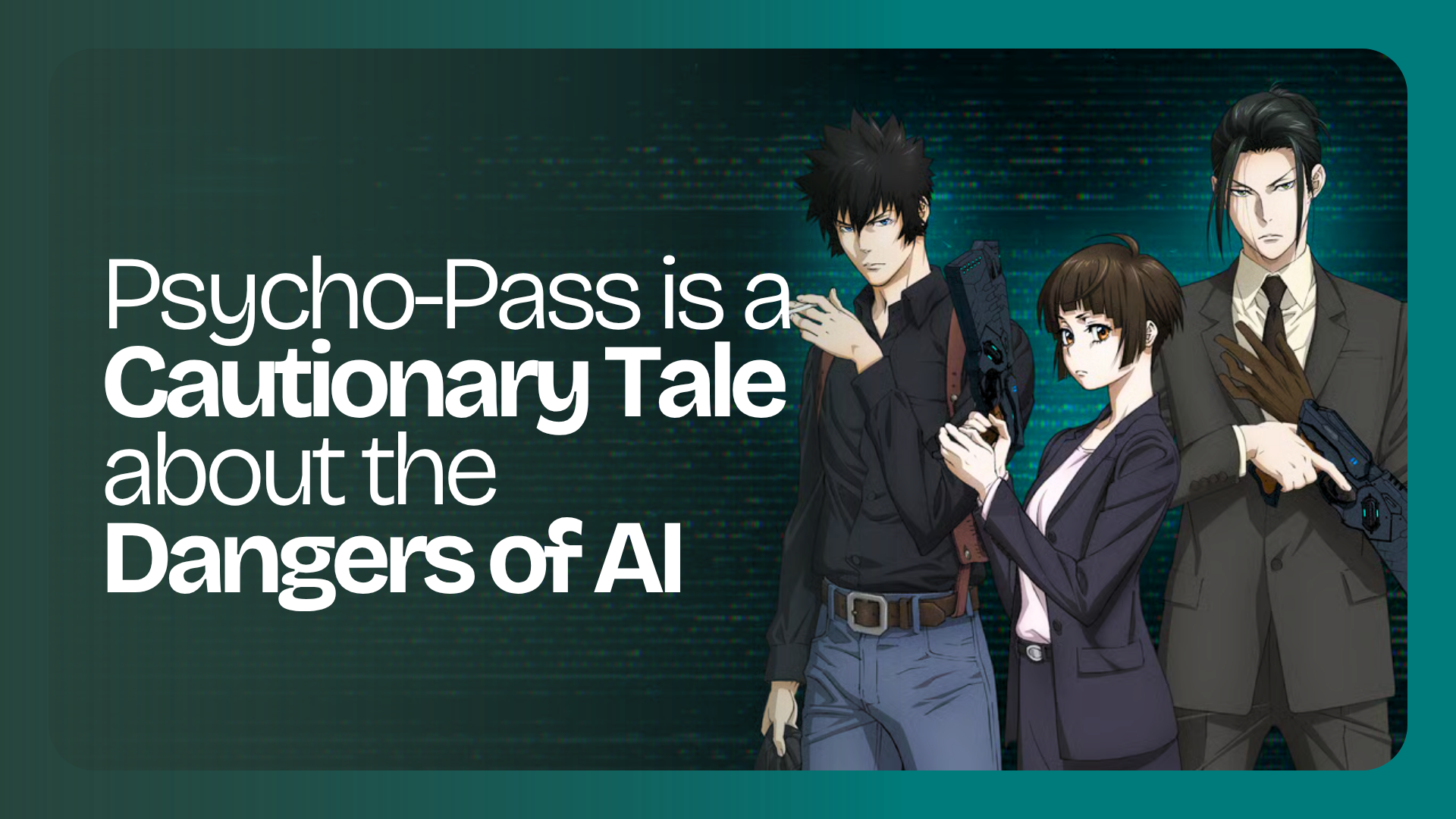
A wise man once said, “To live is not merely to breathe; it is to act; it is to make use of our organs, senses, faculties – of all those parts of ourselves which give us the feeling of existence”. That man was a serial killer. Shogo Makishima, to be exact, is a villain in the amazing anime Psycho-Pass. Despite his psychopathy, Makishima was (unfortunately) completely right about one thing. To actually “live”, you can’t just waste oxygen by passively existing. You must make active efforts to create and sustain a life in your own hands. Now, what on Earth would cause a literal serial killer to go on a hypocritical, philosophical spiel about the significance of humanity? Would you believe me if I said it was because of a kind of villainous AI, and how an entire nation allowed itself to be enslaved by it? Yup.

Psycho-Pass is a sci-fi, psychological thriller that debuted in 2012, taking place in a 2100s futuristic Tokyo (because of course). After national decline, the Japanese government successfully managed to create the ultimate “Utopia” for the nation. Within its borders, citizens lived “ideal” lives free from societal, social, and economic issues–all achieved through the Sybil System. Originally, the Sybil System was a supercomputer whose role was to simply function as a non-human, objective law enforcement body. By use of on-the-spot mental evaluations and criminal convictions based on a citizen’s “crime coefficient” (their probability for committing crimes), it easily maintained citizen safety and peace.
At some point Sybil was enhanced to become a bio-technological hive mind system of “100% objective-minded brains”, but its sole purpose never changed from functioning as a non-human, rational AI unit.

As the system consistently proved its efficiency via impartial decision-making and drastically reducing crime, the government expanded its role to encompass national citizen management. Through its mandated “Sibyl exam”, Sybil took on social engineering duties with the goal to “create a perfect, prosperous life” for each human. In theory, the concept sounded like a path to literal heaven on earth. But consider this: What was once a simple police-computer had now become a national authority that oversaw both citizen management (surveillance) and law enforcement. Doesn’t that sound…ominous?
On the surface, something like Sybil’s existence is a blessing, but a deeper dive would show it is actually a considerable threat to the human experience. Its type of threat is unique, though. Instead of being a violent, “Terminator-like” AI terror, it’s more akin to the dubious Pied Pier, in that it entices humanity into being over-reliant upon and submissive to it. To highlight that fact, let’s refer back to the “Sybil exam” and its life-mapping duties. The system would “suggest” everything from what career you “should” pursue to what hobbies you “should” do–note the air quotes, because these “suggestions” were actually thinly viewed commands.
Citizens no longer had to thoughtfully reflect on how to live their lives. Sybil effectively removed the burden of uncertainty about one’s optimal life path. Sounds a bit…not good, right? While the desire not to waste precious life is understandable, one would think that isn’t part of the joys of life, the pursuit of happiness? Of finally finding success after trial and error? Apparently not for those folks.
You hate to agree with a serial killer, but in this case, how can you not?

The overdependency on this supreme AI became even more evident when it literally replaced the actual Japanese government. Due to its “neutral nature” and “perfect efficiency” in providing citizens with a safe, tranquil life, the original government itself had the bright idea of allowing Sybil to appoint its officials. If anyone would be the most qualified decision-maker, surely it would be a one-million-IQ machine with its “unbiased” criteria, and not the human citizens who inhabit the nation, right?
Begrudgingly, this does sound like the most intelligent choice, but just think: A democracy, filled with human government officials, decided to discard the “democracy” requirement of their government in favor of a machine. This once human-powered democracy would rather an emotionless machine assemble and establish its own idea of a “perfect” government. And create rules for civilian laws and management as it sees fit. With these privileges, Sybil could officially run an entire nation autonomously as the judge, jury, and executioner. Sounds…highly dystopian, doesn’t it?
Psycho-Pass‘ dystopian aspect is also emphasized by how Sybil’s law enforcement policies are inherently utilitarian.

Recall the “on-the-spot mental evaluations and crime convictions” that Sybil enacts whenever faced with a “latent criminal.” (Emphasis on “on the spot”, and not a judgment made after investigating the entire situation). Say it caught you raging over stubbing your toe, or being angry/traumatized over losing a loved one–you would be deemed a “potential threat” to society. Best-case scenario, you get tossed into a padded cell for therapy, but worst-case scenario, you get executed on the spot. Blown to anatomical smithereens, actually. In its pursuit of perfect social order, Sybil–who possesses no moral compass or understanding of situational nuance–had often wrongfully institutionalized, incarcerated, or murdered the very citizens it was designed to protect. Unfortunately, though, roughly 90% of the citizens were more than ready to frolic in the fields of this dystopian life.
Let’s link all of this back to modern society and its current (over)use of AI. Much like the Psycho-Pass citizens’ behavior and what Makishima alluded to, a large percentage of people genuinely don’t want to think for themselves. Reliance on AI has led to a general decline in human cognition. The dehumanization of society is a severe consequence. While modern society doesn’t reflect every situation that occurs in Psycho-Pass, who’s to say it won’t? The writing’s on the wall, honestly. It’s not melodramatic or far-fetched to see how it’s on a slow death march into the series’ reality. Because AI is literally incorporated into everything.
Reflect on AI in the academic, corporate, and even labor management settings.

For all the pushback AI tends to verbally receive, a majority of people still engage with it to make their lives “easy”. Like Psycho-Pass’s Japan and the Sybil system, people already ask AI to suggest trivial things. Like what career path they should take “for funsies”, or “what to wear for a date night”. However, these “for funsies” justifications are simply excuses. It’s obvious that there is an underlying desire to eliminate the burden of choice or the potential waste of time. The academic and corporate environments are where the AI issue exists most strongly. Employees are even encouraged to (and happily) surrender their critical-thinking skills to let AI handle the mental labor.
Of course, it’s true that AI can serve as a tutor or assistant in these high-pressure fields. But instead of being a right-hand man, it is the whole man. It’s a slippery slope that people fall down every day into abusing AI. And the expense comes at the cost of one’s cognitive decline and willpower.
On a morally trivial level, AI usages include people using chatbots to roleplay doctors or therapists. America can be granted some leniency, considering our terrible healthcare system. But it’s nevertheless true that only humans possess the necessary mental flexibility and subjective thinking to resolve personal issues. Reality does not follow the black-and-white mindset, or even mirror the intelligence with which AI is constructed.

For all the doom and gloom this academic monologue has, it’s not only to reinforce the “AI IS BAD!” rhetoric.
If there is anything to be taken from this analysis and Psycho-Pass, it’s simply that it is vital to the human experience to rely on one’s own critical thinking and general self. It goes without saying that there’s nothing wrong with wanting a stress-free life with shortcuts. But when it comes at the cost of your desire to “live” by your own human-driven means, use caution. Psycho-Pass is a cautionary tale about how AI will strip humanity of both its evolution and “humanity.” And how easily it will be allowed to do so. Trials, tribulations, and menial tasks are all part of the human experience. To completely eliminate those things is to cease being “human”.