
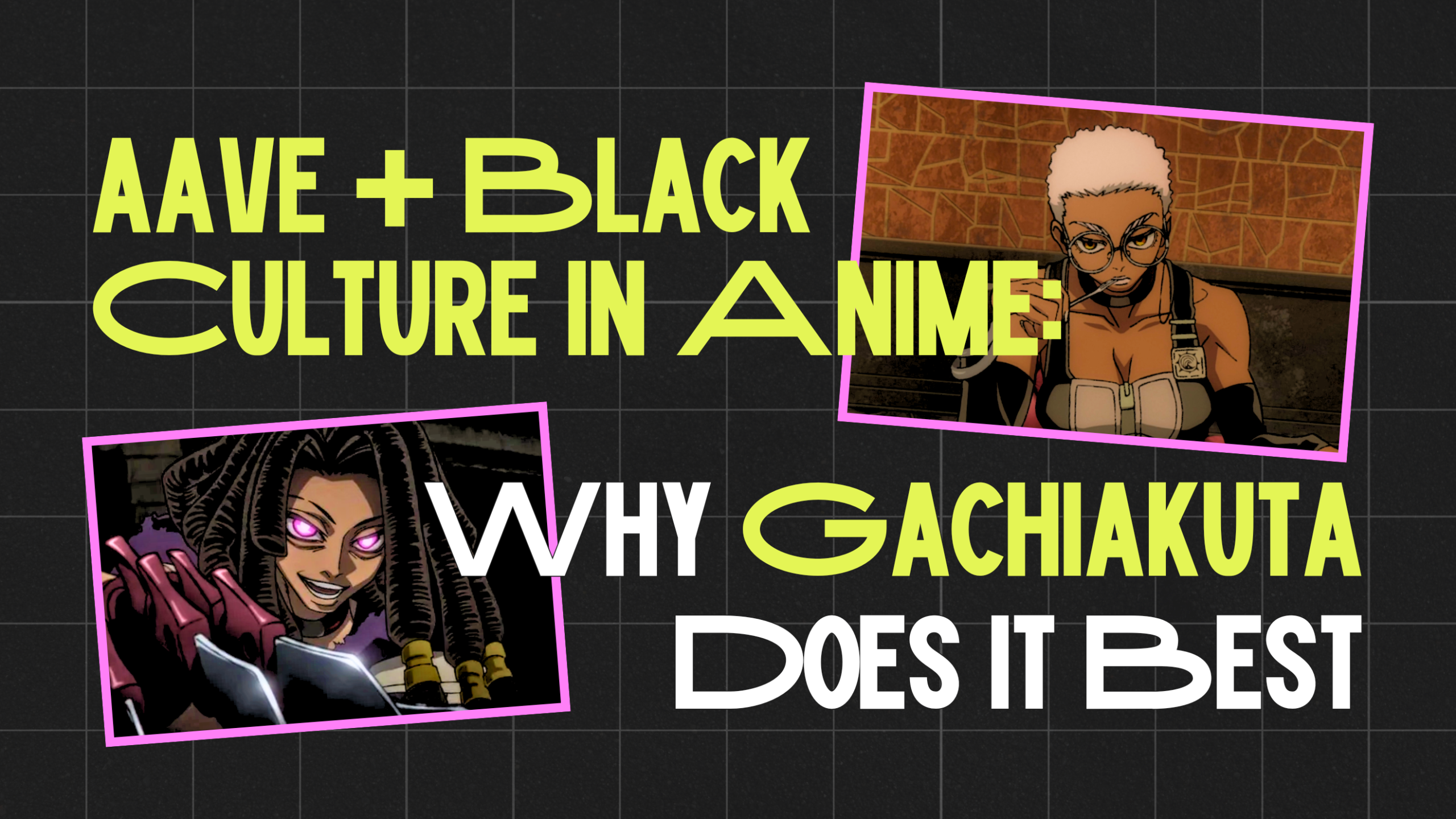
“Because it’s cool!” is the singular thought that has resulted in numerous renditions of any chosen subject matter. Of the most popular subjects that ever had to deal with that phrase, it would certainly be Black culture. Specifically, the African American aesthetic, personality perceptions, and “hood” culture. One would think that, because Black people have always faced the issue of representation in the media, being associated with the word or idea of “coolness” would inherently be a good thing. Which it is, until it starts becoming cringe. Let it be known that for all criticisms made, nothing is to be taken slanderously. Take this as the perspective of an exhausted African-American who simply wants some representational harmony from the media she loves the most.
Black Representation in Japanese media

The portrayal and general representation of Blacks in Japanese media, especially, has notoriously been very wishy-washy. Consider first the character design issue for that category of character. From big-lipped, bug-eyed characters like Shaman’s King’s Chocolove, DBZ’s Officer Black (yeah, that’s their name), and Promised Neverland’s Sister Krone — to boobily-breasted and bodaciously sexual brown-skinned girlies.
The designs tend to be extremely morally questionable. In regard to the sexualization aspect, there is no better example that emphasizes the sentiment more than adult Japanese media. Just think about it: Whenever brown-skinned women are included, they are often put in the most grotesquely sexual and degrading scenarios above all other character types. And hell, they are even awarded their own category as proof of the hypersexualization.

Even in Bleach (we love you Kubo), for all its Black/Black-presenting characters, there is still a ghostly shadow of fetishism lingering around the visuals. Take characters like Yoruichi and Halibel, for example. Though one can certainly argue that all the girlies are drawn in such a way, so there’s that.
Non-Black character portrayals aside, poor use of African-American culture in particular can also be evident in extraordinarily cringey ways. “Hood” culture and the rap genre tend to be represented in Japanese media. Most notably through the usually horrendous use of AAVE or general “hood” mannerisms (Hypnosis Mic, anyone?). While mercy could be given to the awful representation that existed before the “Great Anime Shift” via the excuse of unintentional ignorance, it simply doesn’t hold up now.
No more excuses

There’s so much cultural exposure and knowledge of the do’s and don’ts in today’s society. Coupled with general common sense on how to be respectful, the fact that there’s still a lack of effort in RESPECTFULLY portraying Black/Black-presenting characters is quite damning. Yet, when all hope seemed lost…Along came Gachiakuta.
Created by the mangaka who worked as an assistant to the legendary Atsushi Ōkubo (Soul Eater, Fire Force, also beloved by the Black community). Kei Urana is in a class of her own when it comes to proper representation of Black people and culture. While animation studios have their own say in production decisions, Urana has reportedly been given the rare privilege of working alongside them to bring their vision to fruition. And look at the glorious end results. NOLA beats blasting as OSTs and a reasonable (and dare I say, enjoyable?) use of AAVE. With cool-as-hell Black characters and an overall punk-grungy take on “hood” culture, Gachiakuta pays homage to Black culture in all the delicious ways. Let’s start the series dissection, shall we?
The Characters Are ACTUALLY Black

Japan is a very homogeneous society. Due to the global rise of its animated media, it has only recently become more diverse in its social dealings. But this doesn’t mean that its media has suddenly become a melting pot of cultural/racial representation. Let alone done in an accurate sense. Bad representation aside, there has always been a critical absence of definitively Black or Black-presenting characters. In addition, racial ambiguity in tan- or brown-skinned characters has long been a contentious issue in the anime community. The argument being “Are they Black? Or just a tanned Asian?
Gachiakuta, however, is one of the rare series that does not follow the insulting trend. While Urana never explicitly defined a race for their Black-presenting characters, the series exceeds other greats. She gives all of her Black-presenting characters authentic, common Black features. Features that undeniably confirm their identity. And trust when I say that they are visually appealing, diverse, AND respectful. There may not be as many as there are in a series like Bleach, for example. But quality trumps quantity in this case.
The Big Three

Starting with Corvus, that man is undeniably Black. Not Black-presenting, not Black-adjacent, but straight up, down, sideways, and diagonally, Black. He is a rather burly, richly chocolate-skinned Black man (with a Victoria’s Secret waist blessed by the gods). He sports a mix of freeform locs and what seem to be cornrows. And you certainly can’t have skin like that paired with hair like that without dominant Black genes.
Then you have Semiu Grier (a welcome competition to Yoruichi, in my humble opinion). A Cocoa Queen™ (sorry if that was cringe), who struts around flaunting a fashionable, platinum blonde, low cut proudly displaying her 4C hair texture.
Finally, you have Jabber Wonger. Our resident real freak-a-leek villain. Who apparently takes his loc game as seriously as his obsession with violence (and Zanka). Not to mention his freeform, waist-length locs that are even adorned with some gold ringlets for added Black fashion measure.
With all that said, if you can’t doubt that characters like Corvus, Semiu, and Jabber are considered authentically BLACK characters. If you do, kindly refer to the mangaka’s lovely response to the miscasting of these characters against their direct wishes. Urana advocated for Black actors and to NOT alter someone’s skin color if a Non-Black couldn’t play them.
The Black People Are People, Not “Black” People
Circling back to the issue of inaccurate or simply crude characterizations of Black/Black-presenting characters in anime, another gracious move Kei Urana makes in their series is to create Black characters who are not stereotypical caricatures. What I’m about to say might sound contradictory to this weeb-sertation’s overall point. But Black representation can also be done respectfully when the personality of the people in question is not bound to the confines of their racial identity.
To put it simply, the Black characters of Gachikauta don’t really “act Black.” They are people who are Black, but still act regular-degular like every other non-Black character. Given the “hood-ish” setting of the series, one would think it’d be difficult for Urana to find balance. But amazingly, they do so with no issue (take notes, everyone else).

Taking Corvus as the primary example.
When it comes to characters like his, the stereotypical mannerisms of burly Black men like himself would be heavy use of slang, quick to violence, or just being the “big, dumb, Black guy”. Yet, for all his Blackness, his speech mannerisms and demeanor are all completely normal; educated, even. If his status as the much-respected leader of Cleaners is proof of anything, it’s that it confirms his personality is calm, trustworthy, and compassionate. With the latter shown in how easily he accepted and oversaw the care of the initially hated “Sphereite” Rudo. As a result, we’re given a very cultured representation of a Black man that normalizes him.

Semiu too follows the respectful representation of a Black woman, though for a different reason.
She certainly plays into the stereotypes a tad by using AAVE and acting with a bit of (tasteful) sass one would expect from a stereotypical portrayal of a Black woman. But it’s done realistically, adding relatability and charm to her character. And it’s done in a manner justified by the environment she lives in. All while still wholly possessing composed, non-stereotypical mannerisms. Moreover, since she is a Black woman, one would think she would suffer from the “strong independent Black woman” archetype. But nope; she is equally powerful as the rest of her teammates, with that power not defining her identity.

As for Jabber, his character is mostly done in a way that doesn’t relate to his race (or any) at all.
He’s simply a freak dude who’s out to be Hisoka from Hunter x Hunter’s prodigy, but less…child-centered, and certainly more comical about it. I say “mostly”, because he does have the most prominent use of AAVE, even more so than Semiu. But again, much like the reasons given for Semiu’s use, Jabber’s mannerisms are justified by his environment, and don’t define or overshadow his core character traits. This action was a stylistic choice made by the American localization team rather than Urana. So it’s exclusive to the ENG dub, rather than a canon personality trait. But still, it’s used in a fitting way that is devoid of cringe, and full of fun and humor regardless.
Black People Actually Matter
To add the figurative cherry on top, not only does Urana create these definitively Black characters (rather than throwaway side characters), but they also integrate them into the main narrative.
Consider Corvus once again: As mentioned, his status in the series is head honcho of the Cleaners organization. He is an extremely respected leader and a trustworthy presence. The fact that he’s even a leader to begin with supports his significance. But the fact that he’s portrayed as someone held in high regard is what truly drives home the point that “Black People Actually Matter.”

Then you have Semiu: While she doesn’t share the grand spotlight with Corvus, she is just as well respected and vital to the Cleaners organization. With her level head and cool attitude, she performs her job excellently. She is also someone the Cleaners can consider an invaluable communications handler.
As for Jabber, though he may lack the positive qualities of his fellow Black characters, his antagonistic, masochistic personality still holds significance in the story. He is a direct foil to Zanka and an extremely valued member of the enemy organization. He’s even considered a “genius” for his combat skill (despite how insane it manifests). And you’d be a liar if you denied that.
To make a long, extended “Director’s Cut” thesis short… Urana is the bee’s-damn-knees when it comes to Black representation in Japanese media. Gachiakuta deserves every award in the metaphorical book for all its originality, aesthetic wonder, and attention to racial representation. It would be wise and greatly appreciated if all could follow in their cool footsteps.
Signed,
A satisfied African-American
Love this article so much. Urana is so unapologetic in defining her characters and it’s such a breath of fresh air. Amazing work Tia!