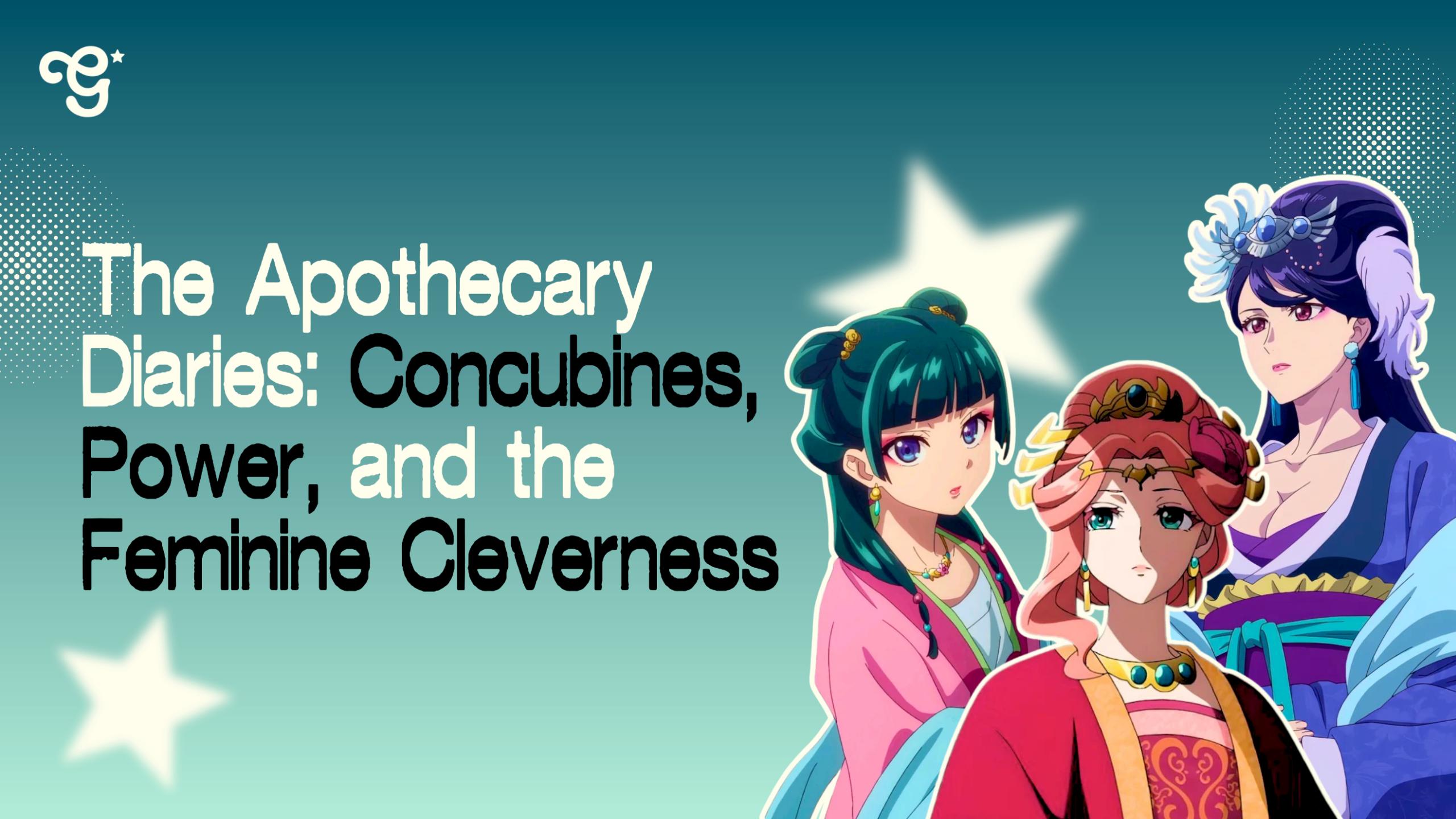
The Apothecary Diaries is almost designed to be romanticized. The Rear Palace is filled with elaborate clothing, beautiful gardens, jeweled hair ornaments, grand banquets, gorgeous consorts, and the kind of imperial luxury that makes palace life easy to turn into fantasy. Women move through decorated halls while competing for an emperor’s attention, political schemes unfold behind silk screens, and even danger arrives wrapped in something beautiful. A story like this could easily make the palace feel aspirational.
Behind the Imperial Palace’s Glamour

Instead, The Apothecary Diaries spends most of its time showing us what all that beauty is hiding. The series is not a literal recreation of one period of Chinese history. Hyūganatsu has been explicit that the setting is fictional and deliberately mixes elements from different eras rather than functioning as a historical record. What the story does take seriously, however, is the gendered logic of the world it has created. The palace may be fictional, but the women inside it still live within structures where marriage, fertility, family connections, beauty, class, reputation, and male favor can determine what kind of life they are allowed to have.
What makes the Rear Palace so deceiving is that beneath all the beauty and luxury, it is really a political minefield. These women are constantly playing a kind of mental chess, and The Apothecary Diaries is especially good at revealing the calculations hiding inside things we might otherwise dismiss as simple femininity.
Beauty as Currency in the Imperial Court

Beauty is probably the most obvious place to start because the Rear Palace makes a spectacle out of it. The consorts are dressed in elaborate fabrics, surrounded by ornaments and attendants, and distinguished partly through how they present themselves. It would be easy to read all of that as aesthetic worldbuilding, but appearance has actual consequences here. Being beautiful can attract the emperor’s attention, and his attention can mean status, security, influence, and greater political importance for the family you came from. Beauty is not the same thing as power, but it can become one of the ways women gain access to it.
That is what makes Maomao’s freckles so interesting. She understands the value of beauty perfectly well and deliberately moves in the opposite direction. Growing up in the pleasure district has already taught her that being attractive can bring the wrong kind of attention, so she alters her face to make herself plainer and easier to overlook. The same cosmetic practice that might be used to increase desirability becomes a way of reducing it. Maomao hides her beauty precisely because she knows how much meaning other people can attach to it.
Unintended Consequences

Lihua’s face powder sits at the other end of that same logic. The women around her use a cosmetic meant to produce the pale complexion associated with beauty and status, only for the lead inside it to slowly poison the body underneath. The powder harms Lihua and contributes to the death of her infant son, turning something associated with feminine beauty into something physically destructive. Yet these women do not understand the danger, while they understand perfectly well that beauty matters.
Both choices make sense within the worlds producing them. Maomao makes herself less desirable because attention can threaten her safety, while women inside the Rear Palace make themselves more desirable because attention can improve their position. Beauty can be a shield in one context and a weapon in another, but its value never belongs entirely to the woman herself. So much depends on who is looking at her and what that person has the power to do afterward.
Rank Doesn’t Always Equal Authority

The palace does something similar with rank. On paper, its hierarchy appears much easier to understand than beauty. Everyone has a position, and those positions determine who bows to whom, who serves whom, and who is supposed to possess authority. Lishu shows almost immediately how little that tells us about the way power actually moves between people.
She is one of the emperor’s highest-ranking consorts, yet her attendants still humiliate, neglect, and take advantage of her. They know she is young, isolated, and uncertain of herself, and they can perform obedience while exploiting the gaps in her confidence and experience. Lishu does have power, but possessing authority and knowing how to exercise it are not the same thing. Her attendants have less formal status and more practical knowledge of the social environment, allowing them to exert control over someone who technically outranks them.
The politics of the Rear Palace are more complicated than men holding power while women simply suffer underneath them. Women participate in the hierarchy too. They protect one another, but they also gossip, exclude, bully, compete, advise, and manipulate. A woman can be disadvantaged by the larger structure while still possessing enough power to make another woman’s position worse.
That is why reading the room matters almost as much as knowing someone’s official rank. Clothing, food, gifts, favors, etiquette, rumors, silence, and relationships all carry information. The women who understand those signals have more room to maneuver than those who understand only the rules on paper.
Gyokuyou Uses Her Position to Her Advantage

Gyokuyou is particularly good at it. Her position certainly gives her advantages, but the Jade Pavilion does not feel different simply because its mistress has a high rank. Gyokuyou inspires genuine loyalty, pays attention to what is happening around her, recognizes competence when she sees it, and knows how to use rank, affection, information, and relationships together.
That gives her real influence. She can protect people, shape the environment around herself, and use her position strategically in ways Lishu has not yet learned to do. But pregnancy changes the stakes because it places a different kind of value on the female body.
The Intersection of Motherhood and Political Ambition
If beauty makes a woman socially valuable, fertility can make her politically valuable. A favored consort becoming pregnant is not simply a private development between a woman, the emperor, and their child. That child raises the question of succession, so the mother’s body suddenly matters to the dynasty, the court, her household, and potentially her family outside the palace.
Gyokuyou shows one side of that.
Her pregnancy strengthens her position because producing an imperial child matters, but it also creates new reasons for people to watch what happens to her. What she eats matters. What touches her skin matters. Who comes near her matters. Protection can begin looking uncomfortably similar to surveillance because the more valuable her pregnancy becomes politically, the more people have a stake in what happens to her body.
Lihua shows another side.

The loss of her child is devastating as a mother, but an imperial child can never be treated as only a private loss. Motherhood inside the Rear Palace exists alongside succession, status, and political consequence. The poisoned powder therefore connects more than beauty to physical danger; it reaches into reproduction itself, harming both a consort and the child whose existence carried dynastic significance.
Ah-Duo pushes that entanglement even further.

There is little about her that suggests she simply failed to understand the world around her. She is composed, perceptive, and deeply familiar with palace life, yet motherhood and succession still shape her life in ways intelligence cannot undo. Her story makes the relationship between mother and child almost impossible to separate from the political questions surrounding inheritance, legitimacy, protection, and the imperial family.
Together, Gyokuyou, Lihua, and Ah-Duo make pregnancy much more complicated than either empowerment or victimhood. Fertility can increase a woman’s influence because the palace values what her body can produce. While making her more vulnerable for exactly the same reason. A woman can genuinely love her child while other people understand that child as an heir, a threat, or a source of political stability. The personal and political are impossible to separate.
Family Duty Comes Before Personal Freedom

Family complicates this even further because the consorts do not enter the Rear Palace as isolated women. They arrive as daughters of families with reputations, ambitions, alliances, and political interests of their own. A woman’s rise can strengthen the people connected to her. Her marriage, pregnancy, disgrace, or disappearance can affect interests extending far beyond her personal life. The romance surrounding imperial concubinage makes it easy to forget that the palace is also where family politics and state politics meet.
Loulan’s story makes that impossible to ignore. She is not simply an unusual consort with constantly changing clothing and makeup. She is also a daughter of the Shi clan, and political expectations shaped her life long before she entered the Rear Palace. Her changing presentation initially looks eccentric, almost playful. But eventually, it becomes hard to separate those transformations from the number of roles she has been expected to inhabit.
Daughter, consort, servant, political figure, family member, and individual self begin overlapping. Loulan becomes remarkably good at adapting to whatever a situation requires, but that adaptability is not proof that the situation itself gives her freedom. There is a temptation to search for the “real” Loulan underneath all of those performances. Yet that may be too simple. People are partly shaped by the roles they inhabit, even when those roles were not freely chosen. The tragedy is that she was never given enough distance from family obligation and political expectation to discover what parts of herself might have developed differently without them.
Can We Separate Ourselves From Our Family Names?

Maomao becomes interesting beside her because she is also the daughter of a politically significant father. But her relationship to that fact could hardly be more different. As Lakan’s biological daughter, she’s connected to the La clan whether she wants that connection to define her or not. Much of the identity she claims comes from Luomen, medicine, and the pleasure district where she was raised.
She can reject Lakan emotionally and refuse to let his status define her. But she cannot make that connection meaningless to everyone else. His position can still affect how she is understood and pull her toward a family relationship she never chose. Loulan is deeply embedded in her clan’s political identity. While Maomao resists the idea that her biological family should define her at all, neither daughter has complete authority over what her birth means.
Cleverness as a Form of Survival

By this point, the difference between power and freedom becomes difficult to ignore. The women of The Apothecary Diaries may become brilliant players, but they rarely get to choose the board. They can read the game, exploit openings, protect themselves, and sometimes gain remarkable influence. Yet the rules determining what choices are available to them were largely written before they arrived.
That is what makes all of this so easy to misread as empowerment. Their cleverness is real. But it is also what they have developed in response to a world they cannot simply leave or remake for themselves. The women are not powerful because the system liberates them, but because they find ways to remain people inside a world that is constantly trying to decide what being a woman should mean for them.