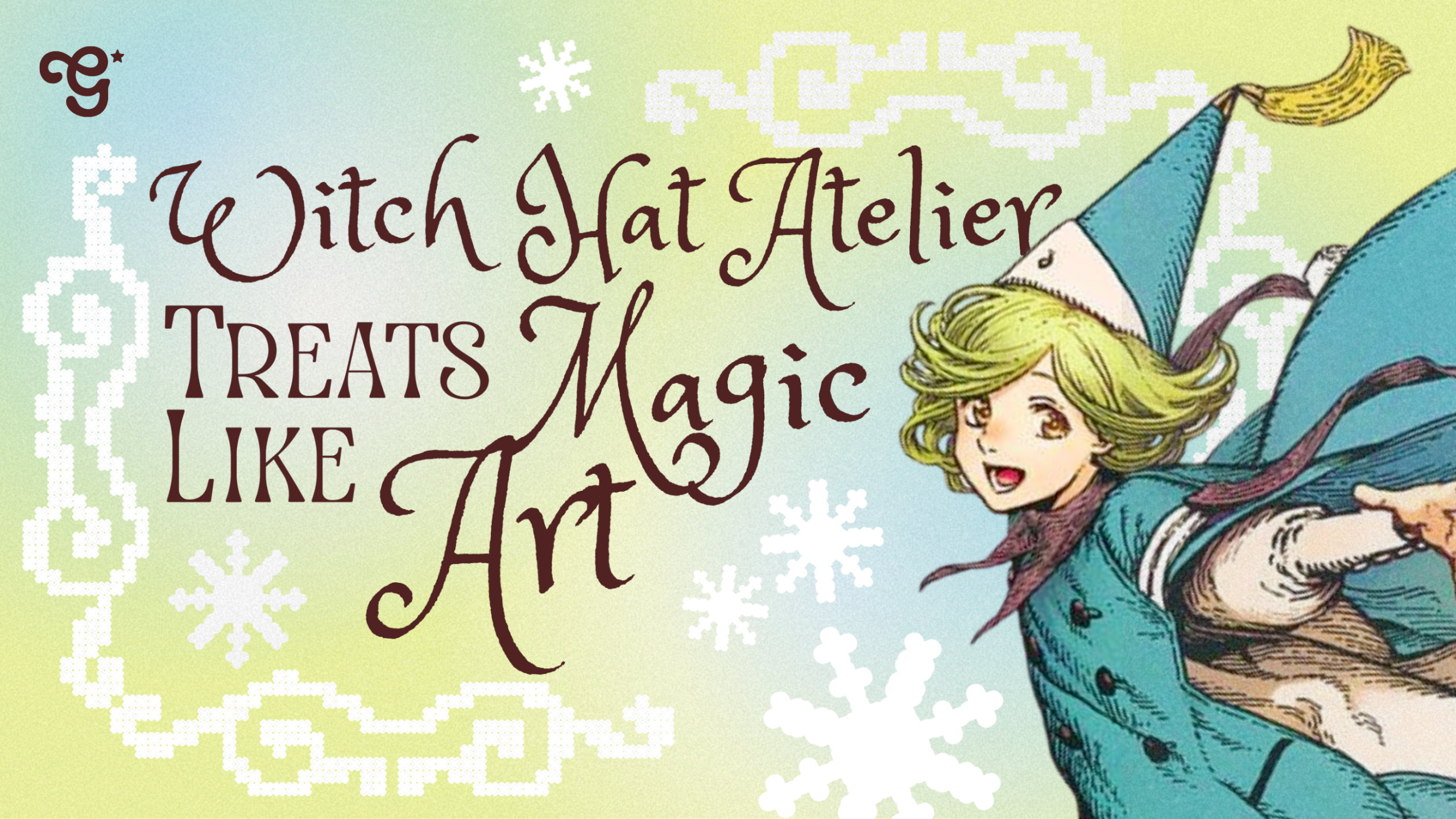
Witch Hat Atelier has one of the most visually beautiful magic systems in fantasy, but what makes it stand out is how closely that magic resembles the experience of being an artist. Witches do not simply possess power and learn how to control it. They draw, practice, copy, experiment, make mistakes, develop preferences, and slowly become more confident in what their own hands can create. The series treats magic less like an ability someone has, and more like a craft someone falls in love with, which makes Coco’s journey feel unusually familiar to anyone who has ever cared deeply about making something.
Coco begins with the same relationship many people have with art before they learn how to make it themselves. She sees the finished result. Magic looks effortless in Witch Hat Atelier because she has no access to everything happening underneath it. Witches draw a few lines, complete a circle, and something beautiful appears. There is no visible history of failed attempts behind the spell or evidence of the hours spent learning what each symbol means. Coco only sees what these people can already do and assumes the difference between them and her must be something innate.
Art can create the same illusion.

Looking at someone who has drawn for years can make their ability seem almost natural because most of the work that went into it has disappeared. You see the finished illustration rather than the hundreds of bad ones that came before it. You see someone draw a hand confidently without seeing how many terrible hands they had to draw first. Even knowing where a fold should sit on fabric or how much pressure to put into a line can look effortless once someone has repeated it enough times. Skill hides its own history surprisingly well.
Once Coco learns how magic actually works, that hidden process becomes impossible to ignore. Knowing that witches draw spells does not immediately make her capable of drawing them well. She still has to train her hand, memorize symbols, understand how they interact, and learn how small changes can affect the final result. She can know exactly what she wants the spell to do while still lacking the ability to execute it correctly, which captures one of the most frustrating parts of learning any creative skill. Artists know that gap between imagination and execution incredibly well. Sometimes the image in your head is completely clear, but the version on the page looks nothing like it. You know the expression is wrong without knowing how to fix it.
Knowing what good work looks like does not automatically mean your hands know how to produce it.

You can tell the proportions feel strange or the pose lacks movement, but your ability to recognize the problem develops faster than your ability to solve it.
Coco spends much of her early training inside that gap. She watches people who know more than she does, studies their techniques, copies what works, and repeats things until they become easier. Over time, learning also changes what she notices. A spell that once looked like one complete miraculous thing begins breaking into individual decisions. She starts understanding what each symbol does, how different pieces interact, and how changing one part can create a completely different result. Artists experience that same shift as they learn their own medium. Before learning to draw, an illustration can simply look beautiful. Once you start drawing yourself, you begin noticing the line weight, anatomy, composition, color relationships, and all the small decisions that previously disappeared into the finished image. The artwork has not changed, but you have more ways to look at it.
Learning does not make the work less fascinating. It gives you more things to become fascinated by.

That is also why the rules behind Witch Hat Atelier’s magic matter so much. Creativity often gets framed as though it comes from complete freedom, while technical rules belong to the boring part of learning. In reality, understanding those structures can create more freedom than less. An artist who understands perspective has more control over the spaces they create. Someone who understands anatomy can exaggerate a body more intentionally. A writer who understands pacing can decide exactly when to slow a scene down or cut something short.
Magic works the same way. The witches share a common language of symbols, but that does not mean they use it in identical ways. Every new technique expands what a witch can combine, alter, or reinterpret. The fundamentals give them control, while their individual choices determine what that control eventually becomes. Coco’s dressmaking background shows this especially well because she does not enter magic without creative instincts. She already understands another craft. She knows how to work with fabric, think about construction, and use her hands to turn an idea into something physical. That knowledge eventually influences how she approaches magical problems. Particularly when she uses her dressmaking experience to help create a magical glider. The scene matters less because it proves Coco is clever and more because it shows how creative skills begin bleeding into each other.
People do not develop a style in isolation.

Someone who sews may notice structure and movement differently. A photographer may become unusually attentive to framing and light. Someone who loves movies may start thinking about composition without realizing it, while a writer may become obsessed with gestures or the rhythm of the way people speak. Eventually, everything someone has spent time noticing starts appearing somewhere in what they make.
That accumulation is what begins turning technical ability into a creative voice. Two people can learn the same fundamentals and still create completely different work because they do not enter the process with the same interests, experiences, or instincts. Learning how to do something correctly is only one part of becoming an artist. Eventually, another question appears: what do you actually like making? Richeh captures that part of the process especially well. Her relationship with magic becomes deeply tied to the kinds of spells she personally values, and she resists being pushed toward forms of learning that feel disconnected from what she wants to create. Her frustration reflects a problem that comes much later than learning the basics. Once someone becomes capable enough to make choices, improvement stops being completely straightforward.
Being technically better at something does not always mean feeling more connected to it.

Artists can become so focused on what looks impressive, what receives praise, or what others consider technically correct that they begin to drift away from what they actually enjoy creating. Studying other artists can improve your work while also making you painfully aware of everything you cannot do. Feedback can help, but too much attention to what other people want can make your own instincts harder to hear. Eventually, growth becomes less about collecting techniques and more about deciding which ones actually belong in the kind of work you want to make. Witch Hat Atelier also lets creativity stay messy. The excitement of learning exists alongside frustration, comparison, uncertainty, experimentation, and the gradual discovery of personal taste. Becoming capable is only one part of the process. Becoming comfortable enough to make something feel like yours is another.
Kamome Shirahama’s own relationship with art makes those parallels feel even more deliberate. She has directly compared Coco’s progression to becoming an artist, describing both as processes built through practice, habits, and accumulated technique rather than effortless genius. She also chose drawing as the foundation of magic because it came from a process she already understood intimately as a mangaka. That decision keeps the magic rooted in drawing as a physical act. The witches need their hands. The quality of a line matters, along with the tools, repetition, and small
imperfections that come with drawing. Shirahama herself still works heavily with physical pens and ink, and she has talked about appreciating some of the smudges and marks analog materials leave behind because they contribute to the atmosphere of the manga. The evidence of the hand does not completely disappear from the finished page.
The parallel becomes almost literal at that point.

Coco learns to control ink well enough to make the things she imagines appear in front of her, while Shirahama uses ink to make Coco, Qifrey, the atelier, the spells, and the entire world around them appear on the page. Both processes depend on hundreds of tiny decisions that eventually disappear into something the viewer experiences as complete.
Shirahama also made an especially fitting choice by designing the magic so readers could imitate part of it themselves. The spells may be fictional, but drawing the glyphs is not. A reader can look at one of Coco’s symbols, take out a pen, and try to reproduce it. Shirahama has specifically talked about wanting that accessibility to encourage readers’ creativity.
Fittingly, that feeling has started moving beyond the story itself. Shirahama intentionally designed the glyphs so readers could try drawing them. That invitation has taken other forms too. Fans have recreated the series through art and elaborate cosplay, with Witch Hat Atelier cosplayers filling events like Anime Expo and appearing together at San Diego Comic-Con in 2026. Shirahama has also described how meeting readers and hearing their interpretations gives her new perspectives as an artist, turning that inspiration into something that can travel back toward the person who started it.
That makes the response to Witch Hat Atelier feel almost like an extension of Coco’s own story.
Coco sees someone make something beautiful and wants to learn how to do it herself. A reader sees Coco’s magic, Shirahama’s artwork, or a costume another fan has made and may feel that same urge to try. Admiration becomes curiosity, curiosity becomes imitation, and eventually someone makes something that belongs to them. Witch Hat Atelier’s best magic trick is not convincing us that ink can cast spells. It is reminding us how often seeing someone create makes us want to reach for a pen ourselves.