Episodes 1-4 discussed, minor anime/manga spoilers mentioned
Crashing and Crushing Out

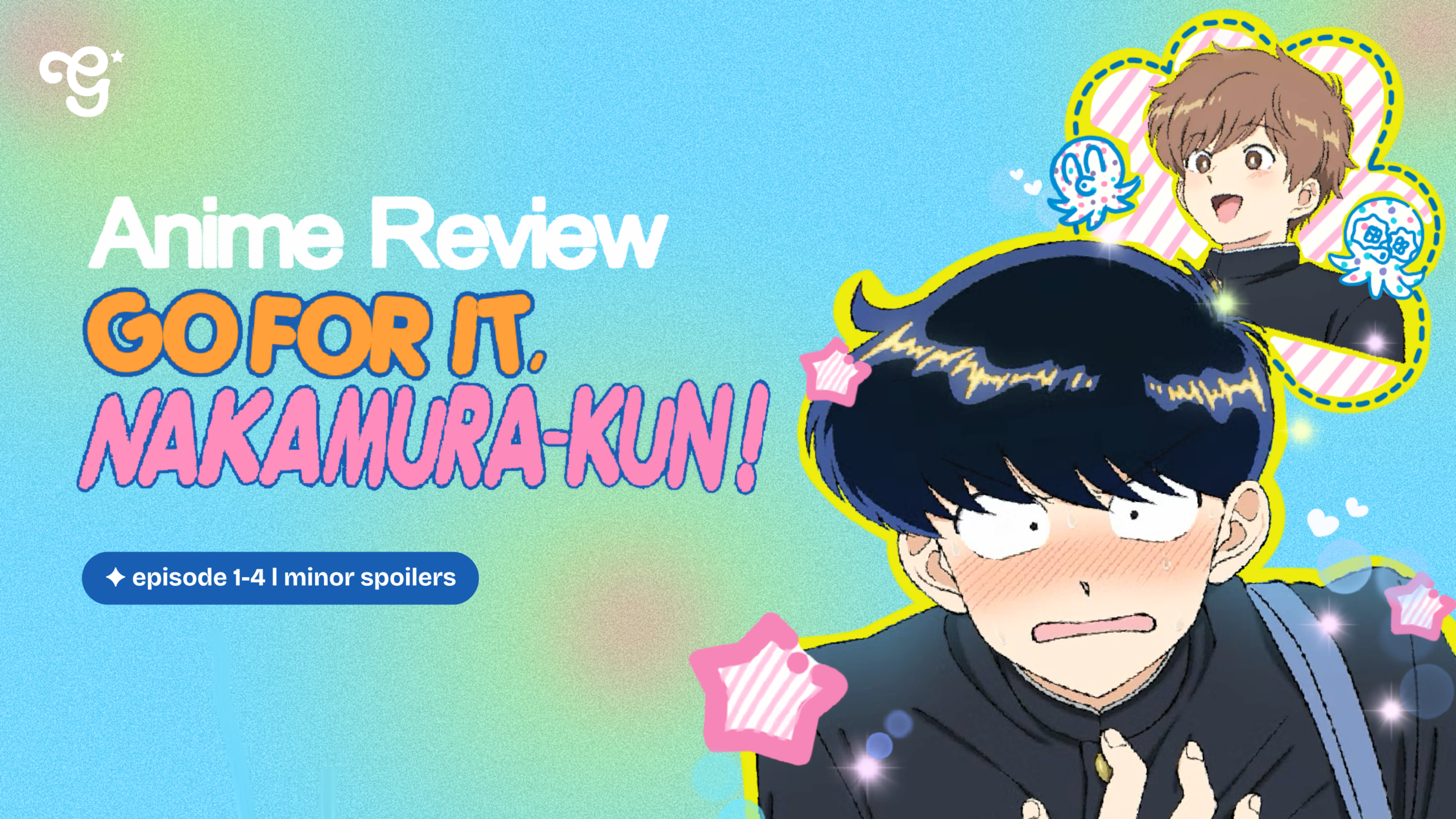
When doe-eyed and rosy-cheeked Aiki Hirose turns to wave at one of his friends during Hoshimi High School’s entrance ceremony, fellow classmate Okuto Nakamura mistakes Hirose’s gesture as an acknowledgment toward him—and it’s love at first sight! Unfortunately, Nakamura is extremely introverted, friendless, and can barely manage a “hello” without spiraling. Can the gap between them ever be closed? Against all odds, Nakamura will give it his best!
It’s exciting to see Go For It, Nakamura-kun!! added to Crunchyroll’s growing catalog of queer stories. It’ll be joining the ranks of their high school romances as a comedy. The series premiered on April 1st as part of an electric Spring lineup. The release date felt spiritually aligned. Nakamura is one of the biggest (and most lovable) fools to recently join anime.
Created by Syundei, Nakamura was originally a character she only ever shared online.

After receiving a call from her editor, she developed the first chapter of Go For It, Nakamura! as a one-shot for the December 2014 issue of OPERA, Akaneshinsha’s BL manga magazine. Go For It, Nakamura! then ran in episodic slice-of-life chapters from 2015-2016.
The series was compiled into a tankōbon volume in 2017, with Seven Seas Entertainment officially licensing it that same year. This makes it the company’s first BL manga title released in English print. The sequel, Go For It Again, Nakamura!, was serialized in OPERA from 2017-2021. The anime adaptation was announced in 2024.
For a story that was originally intended to serve as magazine filler, it’s amazing to see how far it’s come.
Aside from The Demon Prince of Momochi House, I wasn’t very familiar with Studio Drive’s work (they’re also a little difficult to research online). The studio is sometimes described as having early ties to music-related production before expanding into animation through support work. They’ve grown significantly over the years, and although production delays pushed the release of Go For It, Nakamura-kun!! from 2025 to 2026, it was absolutely worth the wait.
Every episode left me immediately wanting another.

Alongside series like Kowloon Generic Romance, Go For It, Nakamura-kun!! leans into nostalgic 80s-inspired color palettes and character designs, while using clean digital animation techniques to anchor it in modernity. When you’re not busy laughing from secondhand embarrassment, it’s extremely easy on the eyes.
The production team ensured the anime stayed true to its retro homage with the opening theme. Yasuyuki Okamura teamed up with Kento Nakajima for “Sudden Spark”—a high-energy pop song featuring arcade-like synths and a chorus so catchy you’ll briefly consider learning Japanese just to karaoke it properly. While the song received praise as an infectious hit, fans were quick to combine the duo’s names into “Nakamura” (a perfect coincidence).
Beyond the score, Nasim Benelkour (Okuto Nakamura) and Morgan Lauré Garrett (Reiko Aokiyama) deserve a mention for delivering such a fun English dub performance. I didn’t care much for Reiko Aokiyama in the manga, but the head of the school’s Horror and Occult Research Club became an unexpected on-screen favorite of mine. I enjoyed the original Japanese performance as well. However, there’s something about the range the English cast brings to Go For It, Nakamura-kun!! that really enhances the humor of the series.
The adaptation maintains the spirit of the manga’s narrative while expanding it with new details and restructuring the plot.

Most of what we see in the anime does exist in the manga, but it’s presented in a different order and sometimes in different contexts.
In my opinion, the chemistry between Nakamura and Hirose feels more natural now. Nakamura’s efforts feel like they could actually go somewhere, unlike in the manga. To date, we still don’t know whether his attempts to overcome his anxiety and win over Hirose ever pay off. And will we ever find out after recent events…?
Since airing, audiences have been going at it over the changes made in the anime. One point of heavy controversy was the removal of a scene in which Nakamura imagines Hirose being bound by tentacles during a classroom cooking setup involving octopuses.
Cuts made to the adaptation reignited debates surrounding Syundei’s use of taboo BL tropes in her work and led to renewed criticism.

The back-and-forth, which unfolded on X, ultimately ended with Syundei leaving the platform. Stating that she no longer saw the point in continuing as a manga creator. While no official declaration of retirement has been made since, HERO’S Web (the Japanese digital platform hosting the manga) later released a statement on her behalf addressing the situation.
While I do find some of Syundei’s recurring motifs questionable, the purpose of this review isn’t to delve deeper into Eastern versus Western interpretation and reception of fictional themes (at least not today). These are important discussions to have, but that’s heavy territory to be getting into over a story about a boy who can’t say “hi” to his crush without crashing out.
The anime is moving through the source material fairly quickly, but I’m hoping it’ll take on a life of its own (a la Fullmetal Alchemist and Fullmetal Alchemist: Brotherhood) and give us a happy ending! This is, after all, meant to be a wholesome tale.
Before I wrap this up, let me share some episode notes I made while watching:

- Episode 1: Delulu is the solulu. Nakamura is insane, but I understand him completely.
- Episode 2: Roaches make dreams come true, but mistaken erotica preferences quickly turn it into a nightmare. I shouldn’t even give context if I write about this.
- Episode 3: The closet fujoshi and closet fudanshi end up in a literal closet in a love triangle that does not, in fact, connect.
- Episode 4: Could Nakamura’s negative aura secretly be a flex if he kept his mouth shut? As I continue to watch the series, he reminds me of a mix of Zenitsu from Demon Slayer and Miyano from Sasaki and Miyano.
While the manga leans into casual homophobia to (presumably) create external pressure shaping how Nakamura expresses his feelings, the anime places less emphasis on othering. Given how much more the adaptation has to draw from his internal, self-imposed conflicts, this shift feels more compelling by today’s standards.
This isn’t some BL epic (unlike Lullaby of the Dawn, which I’m SCREAMING to the gods we get an adaptation for), so there isn’t much more to say about it.
Nakamura’s a teenager who loves octopuses, stays up late reading BL for “research purposes,” and is a hopeless romantic stuck in a constant loop of fantasy confidence and real-world trial and error… with a heavy emphasis on the error. Go For It, Nakamura-kun!! highlights the hilarity (and sometimes tenderness) of teenage awkwardness, yearning, and the gay panic caused by a perfectly timed wave.
Pros
- Positive depiction of queer romance.
- Adaptation changes make the anime more appropriate given the characters ages.
- English dub expands the range of the humor.
- Stylistic choices make it a visually unique contemporary anime.
- The soundtrack makes an amazing playlist.
Cons
- Some fans may not like the changes to the order of events, situational context, and/or sanitized humor.
- Mr. Otogiri and Mr. Niou aren’t a side couple.
NOTE: The details regarding the origins of Go For It, Nakamura! were gathered from the author’s afterword in the volume.