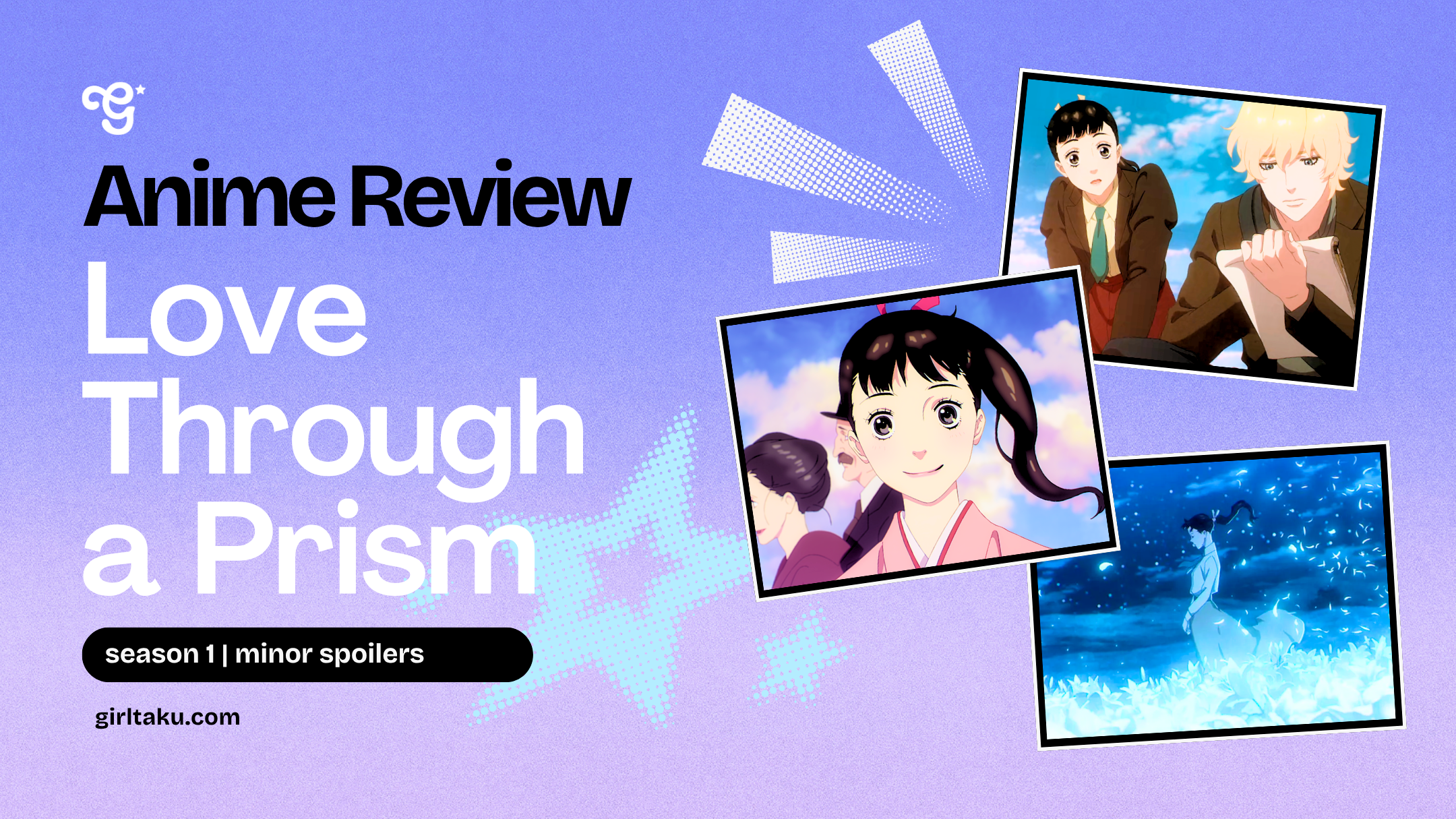
When Lili Ichijoin arrives in England to study at Saint Thomas Art Academy, she’s chasing artistic excellence to outrun a future already mapped out for her back home in Japan. The problem? Standing in her way is the academy’s lone star, Kit Church. He is a prodigy whose quiet intensity feels worlds apart from Lili’s bright ambition. What begins as a one-sided rivalry slowly transforms into something that feels fated in Love Through a Prism.
Contains minor spoilers for the Love Through a Prism anime
Initial Thoughts

Let me rip the bandaid off: The production itself didn’t blow me away. The character animation (especially in the beginning) occasionally clashed with the style of the backgrounds and the showcased artwork. The score worked, but it wasn’t memorable. The voice acting dub wasn’t bad, but it felt shallow in moments where I anticipated more emotional depth.
Does that sound harsh? Maybe a little, but I needed to understand why I was seeing ugly sobs across algorithms in response to this anime. These are elements I fixate on when critiquing a series that provokes such a visceral reaction from its audience.
But I locked in after I came to understand that it was the dimensional narrative making waves.
A Coming-of-Age Story

Jealousy softens into curiosity, curiosity plants the seed of admiration, and admiration blooms into love. What happens when desire, duty, and destiny refuse to coexist peacefully? The answer is both simple and complex… and I’ll reveal my interpretation, but I won’t wait until the end to say you’ll have to watch the anime for yourself to understand why that is.
Now, I won’t peel back every layer, but it’s impossible to write my review without mentioning some type of detail, so here’s your warning. Don’t worry, I won’t overdo it. Love Through a Prism is a coming-of-age anime that uses art as a vehicle to move the plot forward.
The talent within the series is the current that keeps its heart beating. Every assignment, painting, and critique session serves to ask us: What colors define our life? What inspires us to capture a moment before it slips away? Art becomes a medium for memory, and it also serves as an act of resistance. The characters wrestle with topics surrounding family expectations, cultural differences, titles, and the anxiety that comes with choosing your own life. The period setting matters too, because happiness isn’t a simple rebellion away. Neither is love, which in this world is rarely free from transactions meant to secure power or survival.
The Main Characters

Lili and Kit are framed almost mythically. Lili is like the Sun, and Kit is like the Moon. She is impulsive, sincere, and desperate to prove herself. He is reflective, distant, and ruled by unseen tides that he gets swept away in. Their art reflects that polarity, and their relationship forms between these extremes. Their love grows through awareness more than confession. So yes, there’s miscommunication, and it will frustrate you.
The yearning can get exhausting, and the slow burn will test your patience. But that’s the point. This is that kind of shojo. This series will not disappoint you at all if those tropes are your cup of tea. Although I wouldn’t say that the tension was strong enough to endure those cortisol spikes…
Friendship & Sisterhood

I found the most satisfaction in the sisterhood displayed throughout Lili’s friendships, especially with Lady Catherine. The writing throughout her arc was solid. The most beautiful bonds aren’t always romantic. Sometimes, the strongest love you can experience is through the steady hand of a friend guiding you back to yourself.
And in other moments, we are reminded that the only approval that matters is your own. After an assignment asks what it means to live honestly in a fleeting life, Lili decides to return to Japan not because she failed, but because she chose clarity over validation. “You’ve given meaning to my time in England,” she tells Kit. The world does not soften in response to the characters’ growth.
The Male Lead

While I typically don’t care for nepo babies, I was left feeling deeply maternal toward Kit. From the glimpses into his past through scattered flashbacks to the hardships he endured leading to the end, Christopher (as he is known to the aristocracy) is a pawn in a generational game. His father’s confession makes you understand that Kit’s push-and-pull with Lili isn’t just fear disguised as stubbornness. It’s the inheritance of learned restraint. Love Through a Prism makes one thing painfully clear as it nears its climax: Timing is critical, and destiny does not negotiate.
Final Thoughts

I was equally irritated and inspired by the ordeal that is Love Through a Prism. The series doesn’t argue that love conquers all. It shows how to be loved is to be seen. Desire fuels us. Duty steadies us. Destiny tests us. There is no clear victor. Sometimes, surviving is all you get when balance is impossible, or you don’t have the luxury to choose. Viewers are left questioning themselves in a way that feels existential, but necessary. Because even when we put our inner child to sleep to survive the world we inherit, that child never stops dreaming.
Although I am critical of some of the production aspects, the presentation is so unified that it’s still a very satisfying experience. If you watch this series at a glacial pace, then it loses its emotional potency, so I definitely recommend binging. My biggest gripe is that since everything is told through Lili’s POV, there are a lot of loose ends that don’t get cleaned up, especially with the supporting cast.
Pros
- Beautiful depiction of friendships, especially sisterhood
- For true slow-burn enthusiasts
- Satisfying ending (after credits scene)
- It doesn’t really need a second season!
Cons
- Lili’s English dub felt weaker than the rest of the cast
- Although not central to the main plot, supporting characters’ stories had loose ends
- Although relevant to the story, the miscommunication was incredibly frustrating
More Details about Love Through a Prism
Love Through a Prism is an ONA (original net animation), which means the story was released straight to streaming rather than adapted from an existing publication. Yoko Kamio, the mangaka behind Boys Over Flowers, created the story. The anime was produced by Wit Studio, and made its debut on Netflix earlier in the year on January 15th. The manga adaptation, illustrated by Maki Minami, is serialized under Shueisha’s Shonen Jump+ and Manga Mee publications. New chapters are released weekly!