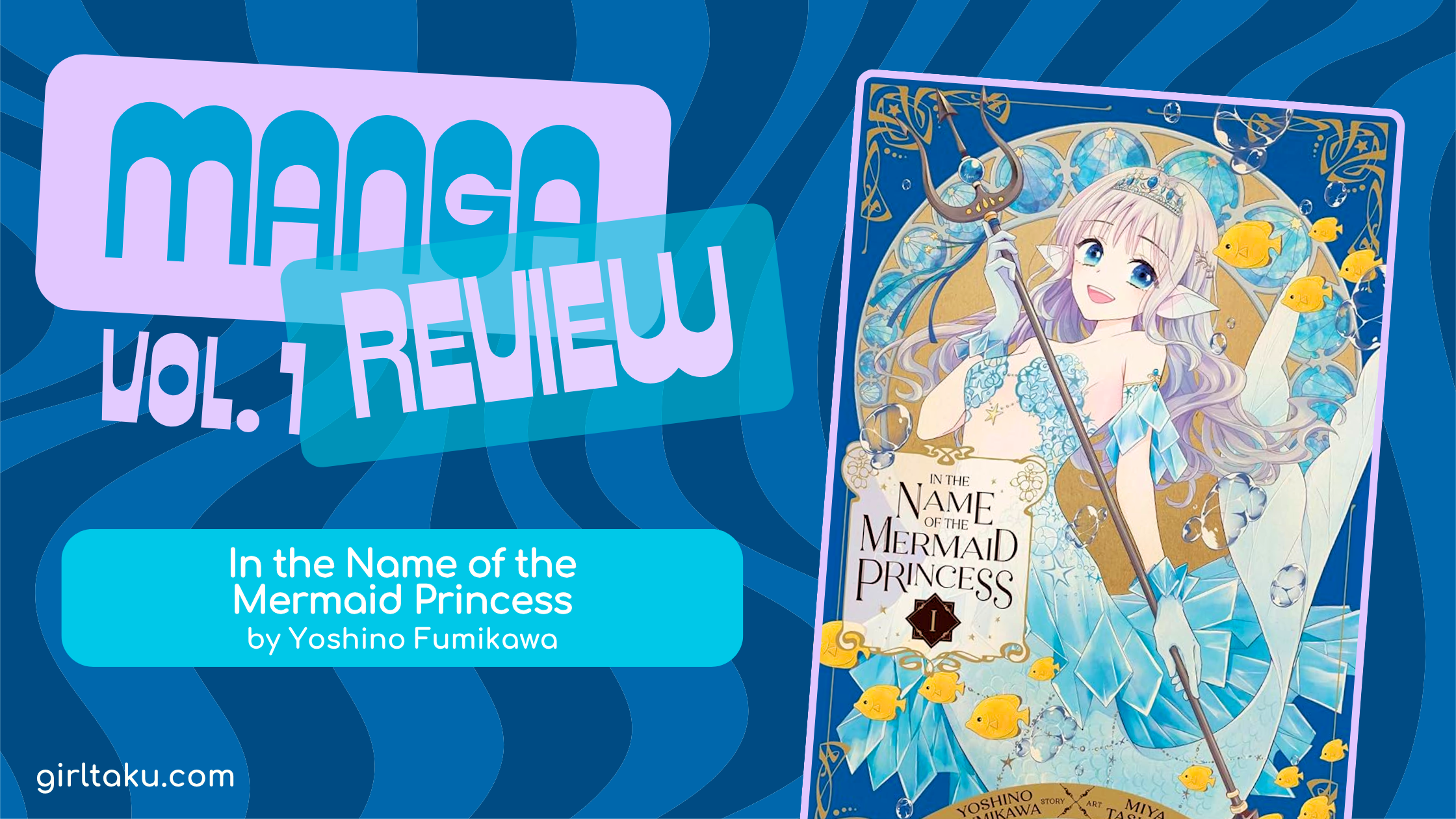
Content warnings: Discussions of Racism, Physical and Verbal Abuse. This review covers volume 1 of In the Name of the Mermaid Princess. Spoilers for volume 1.

Synopsis
Princess Mio is a mermaid, and for her royal family, that’s catastrophic. In this world, society is divided in two: “humans” and “unhumans.” Those born with animalistic features or magical gifts are branded cursed, exiled or erased. When the royal heir is born a mermaid, the king hides her away, medicates her into submission, and forces her to act human. In the Name of the Mermaid Princess isn’t just a fantasy; It’s a story about identity under oppression. Can Princess Mio embrace who she truly is and change the world from her position of power.
The Story
When we first meet Princess Mio, she’s preparing for a political marriage to the prince of a neighboring human kingdom. But Mio isn’t human. She’s a mermaid who’s spent her entire life in isolation, medicated to suppress her true nature. Her “medicine” transforms her tail into legs, and dulls her instincts as well as her magic abilities. She’s been told this is necessary, that her existence is shameful, and that to receive any kind of approval she must be human.

It’s a harrowing first volume as it depicts how Mio has been othered and forced to conform to an impossible standard to erase herself and maintain some illusion of royal purity. Her father, the king, even denies her seawater, forcing her to suffer a thirst that she descibes as torture. Everyone she engages with upholds these standards, and it’s as if no one has any empathy at all.

Then she meets her new tutor, Yuri. Hired to prepare her for living in the neighboring kingdom and to teach her about their customs, Yuri instead opens her eyes to a wider truth. Her kingdom’s hatred of all “unhumans” is on a massive scale, ripping families apart through forced deportations. For the first time Mio begins to question the foundation on which she was raised, and see how those who are not as privileged as she are treated. Is she truly cursed or is society built on a lie?
While the story’s language is often simple, the ideas it tackles are not. It examines the mechanisms that uphold systemic injustice: propaganda, fear, and the illusion of moral order. And it’s told through the eyes of a girl stepping into her power for the first time.

The Characters and Their Role in The System:
Mio
Mio embodies internalized oppression. She’s spent her life believing what she’s been told about herself. She believes she must suppress who she is to be worthy of love. Her journey is one of reclamation of her own sense of self, and embracing the truth she’s always known deep down. Watching her confront her conditioning is satisfying and you can’t help but cheer her on. Her defiance grows throughout the first volume until she demands that the world change, not her.
Yuri
Yuri is not just her ally but is a catalyst for all the changes that occur. He challenges Mio to see how injustice operates. Encourages her to look beyond her own suffering, and see the suffering that exists across the entire kingdom. He makes her recognize her own agency, and demonstrates how to stand up for what you believe in even at the cost of your own safety.

Ugrithe
Ugrithe is the enforcer of the king’s “justice.” He represents institutional cruelty, and his belief in human supremacy feels absolute. Is he pure evil or is he just steeped in a cruel ideology that he can no longer see its harm? He oversees Yuri’s eventual imprisonment, and even goes as far as to have Mio attacked when she’s in mermaid form. His treatment of her is cold and calculating. And although his appearance in this volume is scarce, he feels like the perfect embodiment of how systems dehumanize to uphold the power structure.
Rimore
At first, Rimore seems complicit in the cruelty toward Mio. She’s a handmaiden who ensures Mio behaves and takes her “medicine.” But as the story unfolds, her motives become more complicated. Was she simply following orders in an attempt to keep Mio safe? Her character challenges the reader to question life under tyranny. When does obedience protect, and when does it betray the people you’re supposedly protecting?

Pernice
Pernice’s unraveling is perhaps the most compelling moment in the first volume. As Mio’s servant, initially he despised “unhumans,” parroting propaganda he’s believed since childhood. But in a single moment of empathy, when he chooses to save Mio, his worldview turns upside down. He confesses that he’s never thought to question what he was taught. Pernice’s character exposes how bigotry is conditioned, and breaking free from it requires courage, humility, and empathy.

What makes In the Name of the Mermaid Princess a great read is its clarity. It’s a thinly veiled allegory that parallels real systems of racism, segregation, and forced assimilation. Its villains are not monsters, but institutions that uphold that “the other” must not be seen.
For teen readers, this story is perhaps an introduction to systemic injustice. For older ones, it might feel far too simple. But it’s a reminder of how systems persist when people lack empathy. While it’s not quite a guide for dismantling oppressive systems, it is a reminder that just one person asking questions and challenging authority can have a ripple effect and inspire change.
The Art
If you’re a fan of CLAMP or the work of Arina Tanemura, the art will immediately catch your interest. The character designs are lovely and expressive, with big eyes full of emotion and movement that flows like water. Although at times, the whimsical visuals contrast the brutality of Mio’s reality, that tension just works and it remains emotionally effective.

The Deets
In the Name of the Mermaid Princess is written by Yoshino Fumikawa and illustrated by Miya Tashiro. It is a completed manga in Japan, ending with seven volumes. The manga was licensed for an English release by Viz Media, and the final volume published in August of 2025.