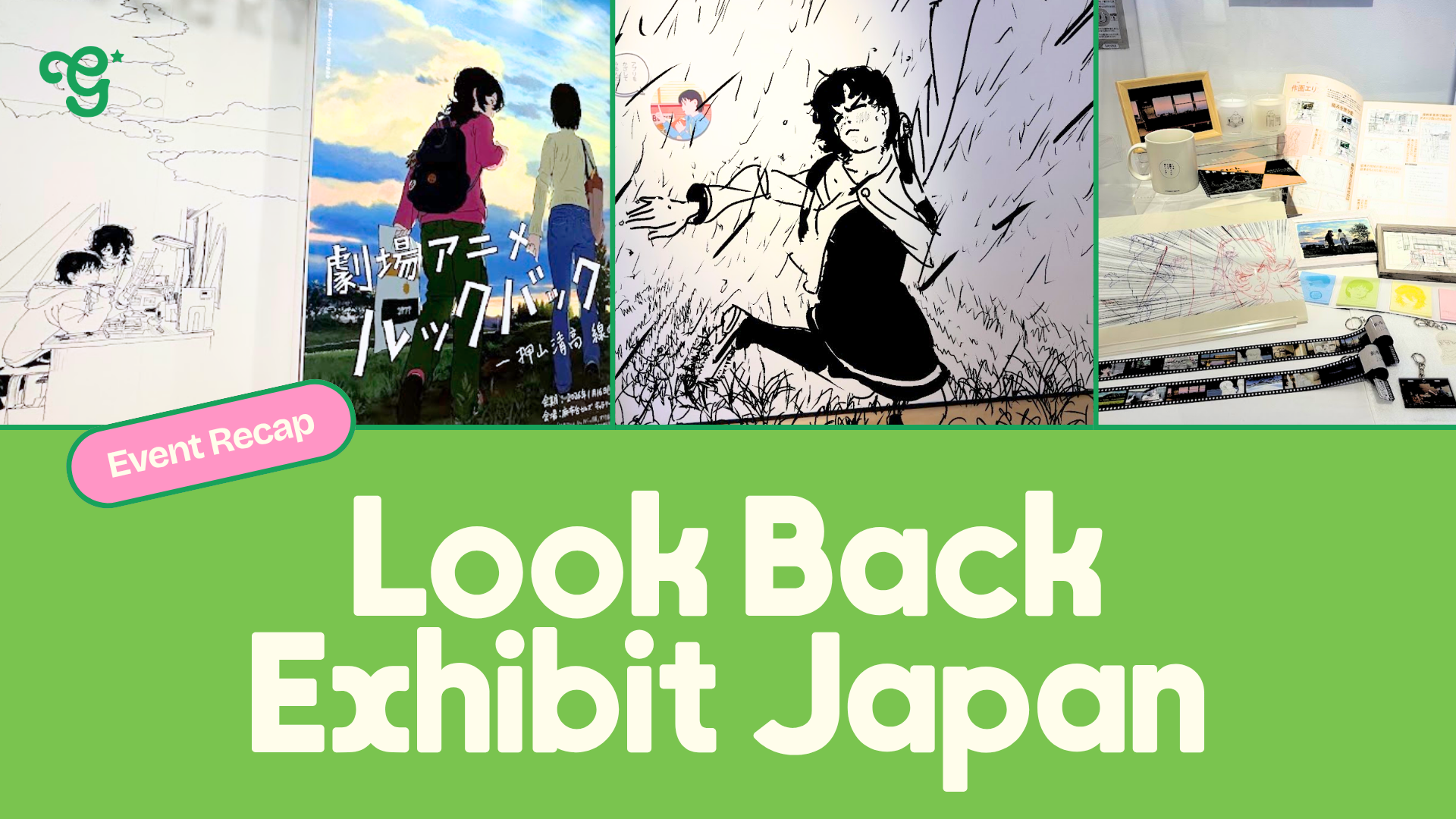
With only two main characters and a 58-minute runtime, 2024’s Look Back builds a devastating, rich world centered on friendship, artistic collaboration, and the arduous journey of the creative process. Fans can now walk through the journey to make the film at an exhibition in Tokyo.

Titled The Emotions of Lines and hosted in the main gallery space of the Azabudai Hills complex, the exhibition is as much a love letter to the passion fuelling each creative as the film is. Photography was permitted but limited to personal use. As a nice touch, the rental audio guide is available only in Japanese and is narrated by Yuumi Kawai and Mizuki Yoshida, the voices of Fujino and Kyomoto, respectively.
Past the elaborate exterior featuring original illustrations by director Kiyotaka Oshiyama, the first space displays a short projection highlighting dialogue serving to introduce the central question of the exhibition — “then, why do you draw, Fujino?” — before turning a corner to fully step inside.
‘The Beginning of Creative Work’, ‘Production’, and ‘Scenes’
The central aim of the exhibition is to highlight the intensive work that goes behind animation. From the storyboards at various stages — including those with mistakes, annotated for reference instead of discarded — to Oshiyama’s real, exhaustive notes for himself and his fellow animators, which are blown up and displayed.
These also offer new insight, such as Look Back being, in part, a reference to Oasis’ “Don’t Look Back in Anger”. However, one of the exhibition’s strongest facets is how it dives beyond the technical making of Look Back specifically into anime industry terms and processes more broadly.

Examples include outlining the type of paper used and the proper terms of the key animations (genga) and rough frames (literally rafu, from the English “rough”, genga), to showcasing the real objects used during production, such as the “cut bags” in which storyboard hardcopies were transported.
These kinds of factoids are featured throughout, making for a treasure trove for anyone looking to really geek out over anime production.
Further, the exhibition is a fully immersive experience. Projections and drawings are suspended from the ceiling. They’re also plastering the walls, accompanied again by dialogue and the movie’s score. Lastly, leading up to the final area, the original draft of Tatsuki Fujimoto’s Look Back manga is showcased for its first public appearance.
‘The Hallway of the Kyomoto House’ & ‘Fujino’s Room’

There are three real-life recreations from the film. First is the iconic hallway leading to Kyomoto’s room — including her stacks of sketchbooks as well as the comic strip which birthed the film’s central friendship — recreated so faithfully it was almost startling to see. Even more moving is seeing Fujino’s room in real-life. Which, was staged adjacent to a replica of Kyomoto’s hanten jacket, complete with Fujino’s autograph.
Beyond feeling transported into the film itself, each detail stirs up the same feelings as the original work. In seeing the room packed with manga, homework, and scraps of sketches. During which, a light projection on the window depicts the changing seasons.
In a special screening room, a short film utilizing documentary footage of production layered over the film’s scenes posits the same question in the exhibition’s introduction: what does it mean to draw a line? With all the endless labor, drafts and mistakes, why does Oshiyama, just as Fujino, still draw? For any fellow creative, it’s an incredibly resonant final note to leave visitors with.
Exit Area & Gift Shop
Along with the premiere of a new manga by Fujimoto called The Cave of the Boy, the exhibition closes on two interactive elements.


One is a VR experience where visitors can immerse themselves in the film’s rain scene using the iPad’s provided. Oshiyama explains his philosophy of embracing new technologies and pushing art forward. As long as they retain the essential experience of physically holding the pencil.
The other is a photo booth where you can choose from three backdrops. Creating a nostalgic, Polaroid-esque souvenir print for only 800 yen.


Offering your standard adorable Japanese gift shop fare (stickers, mugs, candies). The highlights are definitely the items for creatives, like notebooks, sketchbooks, and organizers. There is even a Do Not Disturb door hanger for uninterrupted writing.
Theme Café


While other places in the mall have their exhibition tie-ins, the main limited-time menu is focused on the Azabudai Hills Gallery Café. Which is next to the gift shop area.
With multiple drink choices and two themed crepes, I opted for the Vienna coffee. The drink comprised of black coffee, either hot or cold, topped with whipped cream. The cafe offered an elevated take on the Japanese kissaten classic. The cream blended with a hint of orange and cinnamon and an orange slice and illustrated wafer as a garnish.
Closing Thoughts

Look Back, to me, is required viewing for anyone in a creative pursuit.
An exhibition with this level of detail is the perfect reminder that art isn’t easy. But it also isn’t meant to be. As much as the finished piece, the journey and the drive to get there make an artist.
Opened in November 2023, Azabudai Hills is already setting up a great track record for unique anime exhibitions. Such as 2024’s “Pokémon × Crafts.” Where traditional Japanese artisans created stunning metal, ceramic, and wood pieces inspired by the world of Pokémon.
Even in choosing to highlight a work like Look Back. It seems to reflect the organizers’ desire to offer innovative experiences for anime fans. Let alone the level of detail present in “The Emotions of Lines”. Definitely keep an eye on this space.